Weebou Editorial Team
 8 min read


 In this article
A little preparation
Pick a moment when nobody is rushed, hungry or upset. A child who is already cross rarely wants to be asked to focus, so save these games for after a snack, on a quiet afternoon or at the end of a walk. Say plainly that the game is optional and that your child can stop whenever they like. Keep eyes open, allow wriggling and let your child stand, sit or lie down.
Adults go first, briefly and specifically: "I can see a scratch on this block and it feels cool." Keep each game to two or three minutes at first. Choose familiar objects rather than strong smells, unusual textures or surprises, and avoid asking children to notice their breathing or body unless they bring it up. If a game starts to feel like a test, change the question or end it. For a wider range of calming games, see gentle games for big feelings.

What to know and try
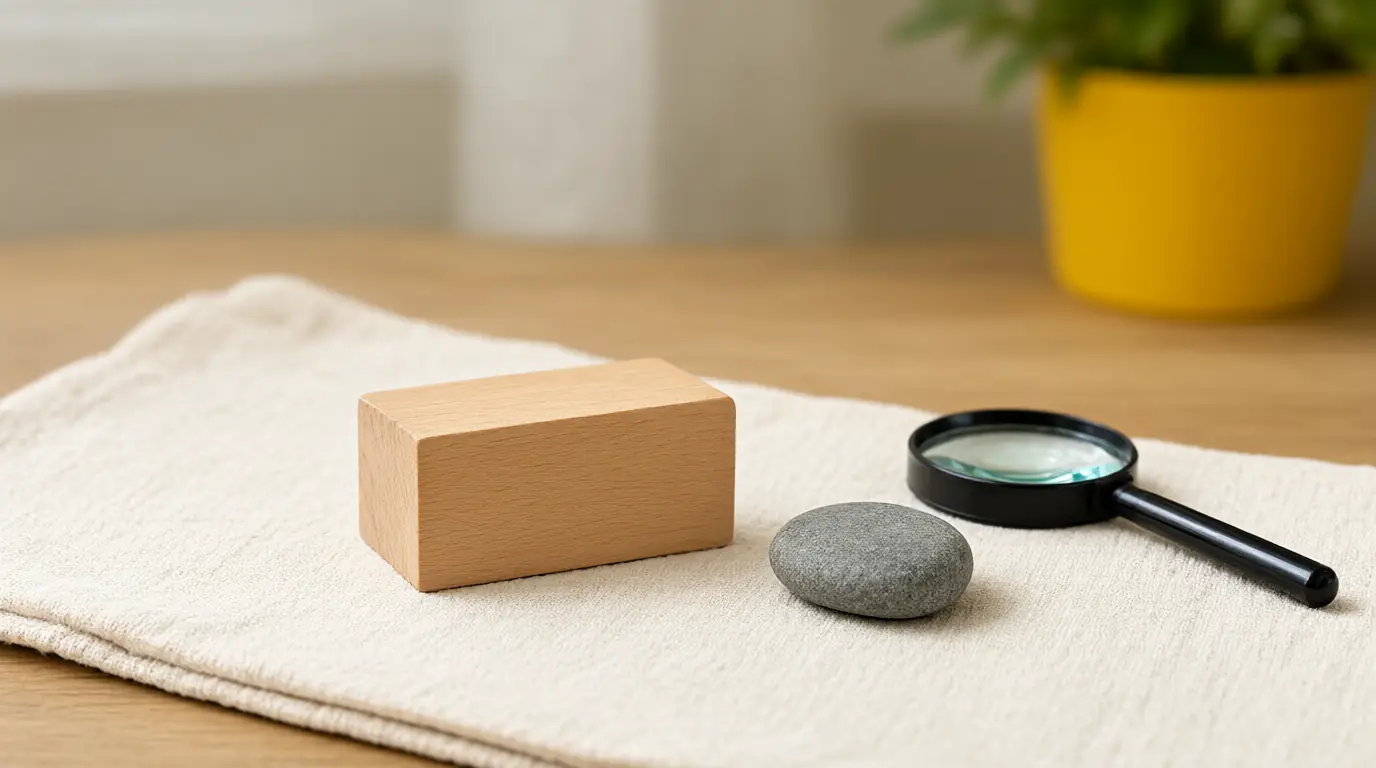
Be a tiny explorer with one object
One ordinary object gives a child something concrete to look at, which is easier than being told to concentrate on nothing. A smooth block or pebble has edges, marks and a temperature to discover. Taking turns to point out details keeps the game social, and a child who prefers to look without touching can still take part fully.
 You’ll need
- A large smooth wooden block or pebble
- A plain cloth or tray to rest it on
- A small magnifying glass (optional)
How to do it
- Place the object on the tray where both of you can see it.
- Say one thing you notice, such as a corner, a colour or a tiny scratch.
- Invite your child to find something you have not mentioned yet.
- Offer to touch it if they want to, and ask whether it feels warm, cool, rough or smooth.
- Turn it over and see whether the other side looks the same.
- Finish by letting your child decide whether to look again or put it away.
Make it your own: Younger children may only point and nod, which counts. Older children can compare two objects and say what is different, or try to describe the block so you could pick it out of a bag.
Take a slow noticing walk
A familiar route becomes new when the job changes from getting there to looking for one thing. Choosing a single focus, such as things that move in the wind, keeps the game small. The slow pace also gives a child time to stop at whatever catches their eye, instead of being hurried past it.
You’ll need
- A short, familiar and safe route
- Comfortable shoes
- A small bag for one found leaf or stone (optional)
How to do it
- Choose one thing to look for, such as moving leaves, a bird, a colour or shadows.
- Walk at your child's pace and stop whenever they want to show you something.
- Ask for one sentence about what they found, without correcting or adding facts.
- Offer a slow-motion section where you both move in extra-slow steps for ten paces.
- At the end, point out one thing you noticed and ask what stood out for them.
Make it your own: For a toddler-sized attention span, make it a single pause at the garden gate. For older children, change the focus halfway: now find something that makes a sound, or something that is smaller than their thumb.
Listen and point to a sound
Sounds are a gentle way into noticing because they are already there; children do not have to make anything happen. Pointing to where a sound comes from adds a small physical job, and deciding whether it is near or far gives the game a question to answer. It also works in a car, waiting room or bedroom.
You’ll need
- A small bell or a metal spoon and a cup
- A comfortable place to sit
- A soft cushion or mat
How to do it
- Sit together and say you are going to listen for sounds already in the room.
- Wait quietly for about ten seconds and point toward the first sound you hear.
- Ask your child to point to a different sound, then decide together whether it is near or far.
- Ring the bell softly once and let your child follow the sound until it fades.
- Swap roles: your child makes a gentle sound and you point to where it came from.
Make it your own: Keep volume low for children who dislike loud noises, and let them hold their hands over their ears if they wish. Older children can count how many different sounds they hear in one minute.
Draw one moment you noticed
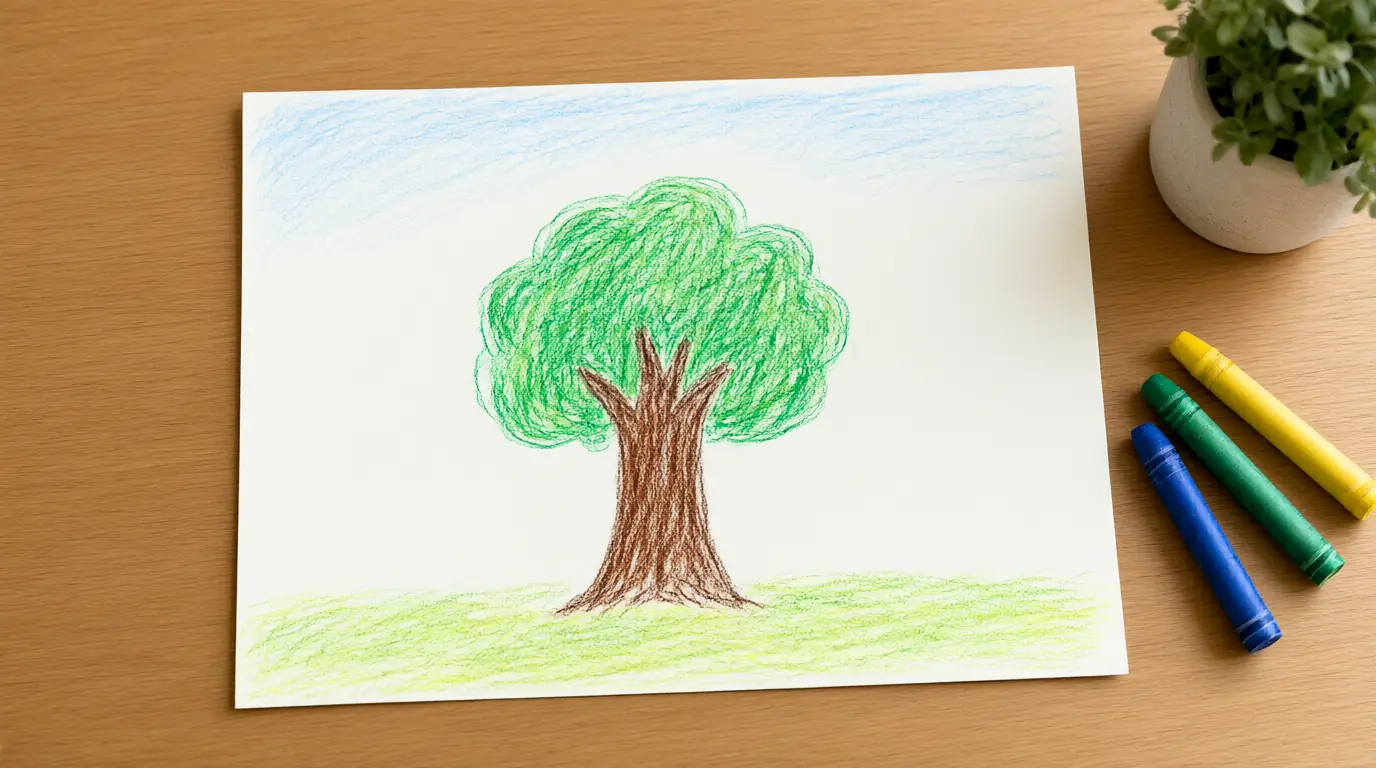
Drawing gives noticing an outlet, which helps children who find sitting quietly difficult. The picture does not need to look accurate; its job is to hold one detail that mattered. Asking which part they chose, rather than what it is, keeps the focus on their attention and not on the standard of the drawing.
You’ll need
- Thick crayons or markers
- A sheet of paper per child
- Something to look at: a tree, a toy or a patch of sky
How to do it
- Look together at a tree, a toy or the sky for about thirty seconds.
- Invite your child to choose one detail they would like to remember.
- Draw while you both talk about colours or shapes, if they want to talk.
- Ask which part of the picture was the most interesting to look at.
- Look at the real thing again and see whether they want to add anything.
- Decide whether to keep, share or fold the picture away.
Make it your own: Offer sticky notes so even a single line or dot counts as a finished picture. Older children may add a few words or a number to say how long they looked.
Make a quiet noticing jar
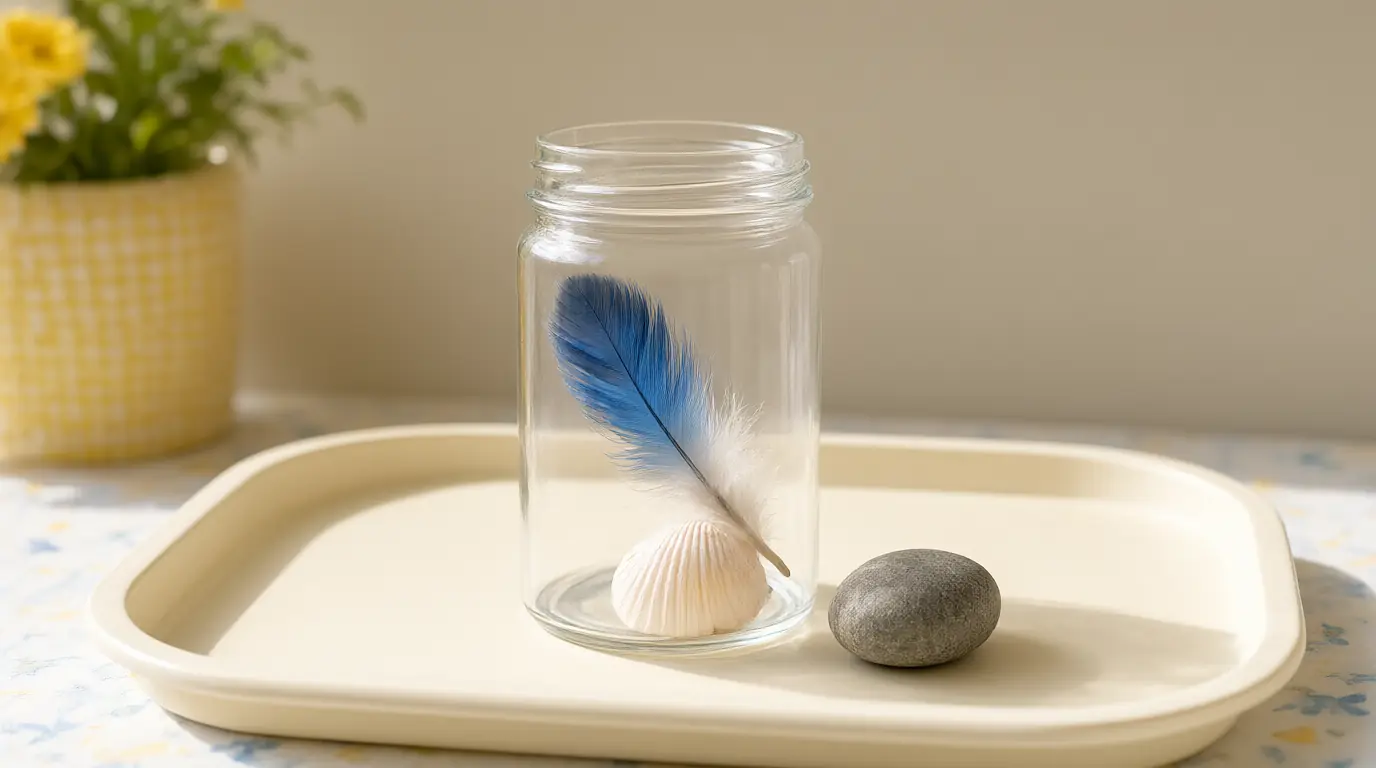
A noticing jar is a small collection of things a child has chosen to look at slowly, such as a feather, a smooth shell or a button. Each one is picked because it offers something to see or feel. The jar can become a calm-down corner for children who like objects, but only if they choose to use it that way.
You’ll need
- A clear plastic jar with a screw lid
- 3 to 5 safe, larger-than-mouth-size objects such as a feather, shell or wooden bead block
- A tray to empty the jar onto
How to do it
- Collect objects together on a short walk or from around the house.
- Check that each item is too large to swallow and has no sharp edges.
- Place them in the jar and close the lid together.
- Tip them onto the tray and pick one to look at for a moment.
- Say one thing you notice about it, then invite your child to do the same.
- Put the objects back and choose a place for the jar.
Make it your own: For younger children, keep to two or three objects and supervise closely. For older children, sort the objects by colour or texture before putting them back, or hide one while their eyes are covered and see if they can tell which is missing.
Make it work for your family
If a child says they are bored, treat that as information rather than failure. Shorten the game, hand them the leading role or swap to a more active version, such as slow-motion walking. Never promise that noticing will make a feeling go away; it is simply a way of being curious together. These activities are play ideas, not treatment for anxiety, sleep problems or other difficulties. If a child seems distressed by quiet, or if worries are persistent, speak to your doctor, health visitor or the child's school.
One useful habit is to notice out loud during ordinary routines: the sound of the kettle, the warm water on hands, the smell of toast. Fifteen seconds is enough. Match the length to your child rather than to a target. For outdoor looking games with more structure, try an outdoor scavenger hunt or a few low-key concentration games.

Parents also ask
How long should a mindfulness activity last for a preschooler?
Two or three minutes is plenty for most children aged 3 to 6, and many will stop sooner. Follow your child rather than a timer. A short, positive experience that ends when they lose interest is more useful than a long one that feels like a chore.
Does my child have to close their eyes or sit still?
No. Keeping eyes open and moving around is perfectly fine, and often easier for young children. The point is to look, listen or feel something real for a short time. Movement games like slow walking count, and a child can always choose to just watch.
What if my child finds quiet activities upsetting?
Stop and switch to something active or sociable. Some children find silence uncomfortable, and that is not a failure. If quiet moments or worries seem to cause regular distress, talk to your doctor, health visitor or your child's school rather than trying to push the activity.
Choose materials and activities that suit your child, supervise as needed and adapt the ideas to their interests and abilities. About our editorial approach