Weebou Editorial Team
 10 min read

 In this article
A little preparation
Choose one room or a corner of the garden and clear the floor first: blankets, toy boxes and chair legs are the usual trip hazards once a game speeds up. Decide on one signal for go and one for stop, and make them different in kind, such as a green card for go and a familiar word for stop. Show both slowly while everyone is calm, and act them out yourself so your child sees an adult pausing too. Ten minutes is usually plenty.
Keep all movement to a slow walk, and leave fast running for soft ground outdoors. Nobody is ever out of the game, and there is no losing a turn. Agree before you start that anyone may say 'pause please' and sit down for a round, and that the adult will model that too. If you are playing on a hard floor, bare feet or non-slip socks are safer than smooth socks, and the route should stay away from stairs and glass. Practising a pause is easier in short, cheerful bursts; for more movement that stays gentle, see these balance games with feet close to the ground.

What to know and try
Go and stop with picture signals
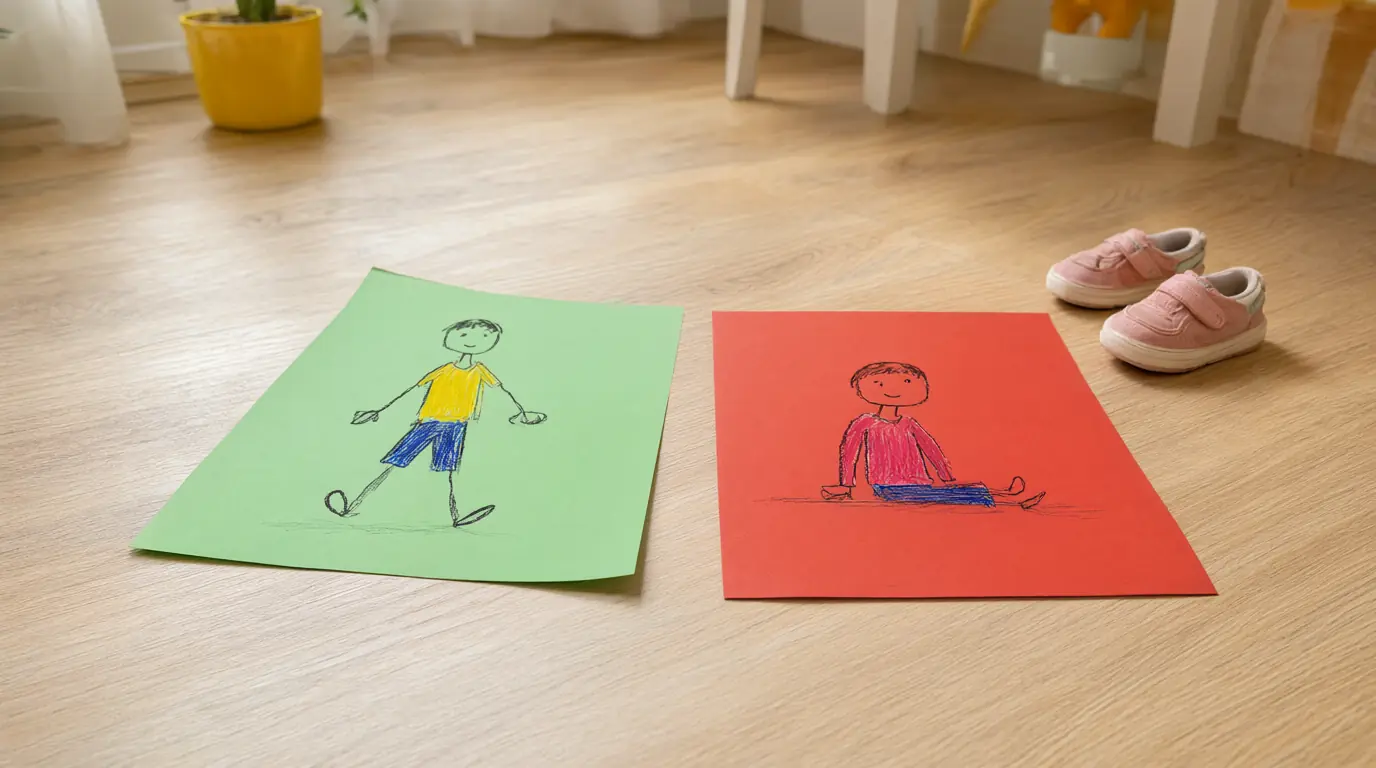
Picture signals work because they are visible from across the room and can be checked without hearing anything. Holding up a walking card and a resting card turns an abstract instruction into something a child can hold and copy. Letting your child become the signal-maker is often the moment the rule clicks, because they see both sides of the game.
 You’ll need
- A green card with a drawn walking figure
- A red card with a drawn sitting figure
- An open floor with a clear path
- Non-slip socks or bare feet
How to do it
- Show both cards in a calm moment and act them out yourself: walk while the green card is up, sit still while the red card is up.
- Stand a few steps away from your child so they can see the cards without effort.
- Hold up the green card and walk slowly on the spot together for a count of five.
- Change to the red card and stop together, keeping your feet still and waiting a little longer than feels natural.
- Trade places after three or four changes and let your child hold the cards.
- Add a third signal, such as a bell, only once the first two feel easy.
- Finish with a red card and a shared rest, so the game ends settled rather than suddenly.
Make it your own: Two-year-olds need longer gaps between changes and can copy your movement rather than interpret a card. Four- and five-year-olds can add a hop, a tiptoe or a backwards walk. If standing still is hard, offer a sitting version with hand movements instead.
A parking lot for toy cars
Driving a car into a parking space gives the pause a purpose: the vehicle has somewhere to be, so stopping is the goal rather than the interruption. Children who resist a spoken 'stop' often accept a road that simply ends, and a tape line is easy to see on a wooden floor.
You’ll need
- A few toy cars or trains
- Masking tape or a long scarf
- A shallow box or a taped parking bay
- A cushion or rug for kneeling on
How to do it
- Mark a simple road with tape on the floor, wide enough for a hand to push a car along.
- At the end, tape a rectangle for the parking bay, or use a shallow box tipped on its side.
- Drive one car yourself first and park it, saying nothing more than 'home'.
- Take turns pushing a car along the road and stopping it inside the bay.
- Make the bay wider if the car keeps rolling past it, rather than repeating a warning.
- Let your child add a petrol stop halfway, so the route holds two pauses.
- Park every car at the end, then ask which one is easiest to stop.
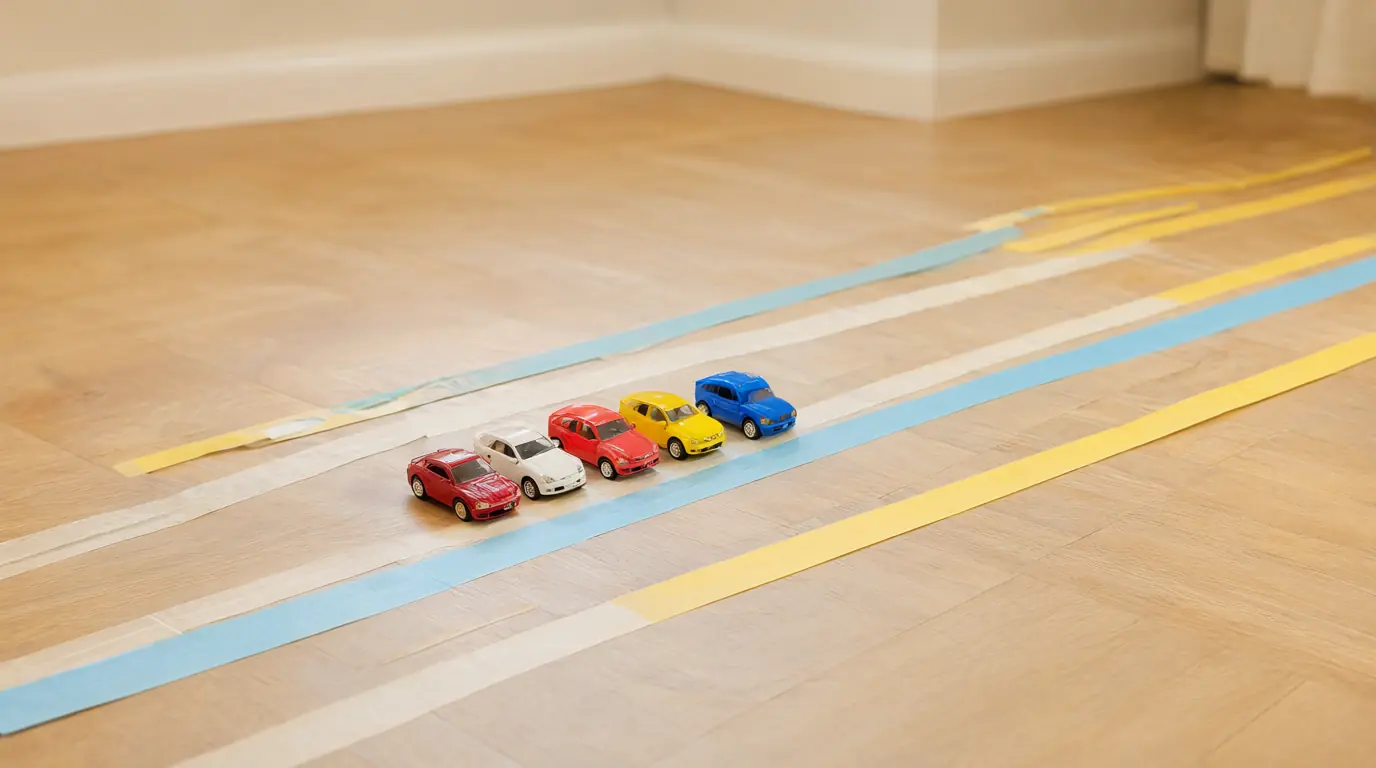
Make it your own: Younger children can push the car while you tap the bay as a signal. Older ones can add slow and fast zones, or a gentle rule that a car may only move while someone is humming. Very small cars that could be swallowed stay out of reach of children who still mouth toys.
Slow-motion mirror, then freeze
Copying an adult's slow movements asks a child to watch closely and match a pace, and the freeze arrives as a natural ending to each shape. Slow movement is easier to interrupt than fast movement, so the pause succeeds more often. Keeping a straight face is not part of this game.
You’ll need
- Open floor space
- A scarf or ribbon for the leader to raise
- Socks or bare feet on a non-slip floor
How to do it
- Stand facing your child and say you will move in slow motion, like honey being poured.
- Lift one arm slowly and invite your child to copy it, taking about five seconds.
- Freeze in that shape and count to three together while staying still.
- Move into a second shape and then a third, announcing each freeze by stopping your own movement.
- Let your child lead the next round and choose how long each freeze lasts.
- Try two freezes in a row if your child wants a bigger challenge.
Make it your own: For a two- or three-year-old, mirror one arm only and sit on the floor so balance is not the challenge. Older children can freeze on a raised leg or with eyes closed. A child who cannot hold still can freeze a hand, a head or an elbow instead.
A story clue that pauses the toy
Hiding a pause inside a story keeps the attention on the plot rather than on stopping. The child listens for one familiar word, and the toy only moves when that word arrives. A single clear clue repeated several times is more satisfying than a puzzle, and the child can take over the telling.
You’ll need
- One favourite soft toy
- A rug or a paper map drawn in crayon
- Two or three landmarks, such as a cushion and a box
How to do it
- Draw a path on paper, or lay a scarf across the rug as the road.
- Place a cushion as a hill and a box as a cave along the route.
- Tell a short journey and agree on one clue word, such as 'river', that means the toy may move one step.
- Move the toy each time the word arrives, and stop whenever it does not.
- Pause in the middle and let your child tell the next part of the journey.
- Use the same clue word in each round rather than changing it.
- End with the toy arriving somewhere and resting there.
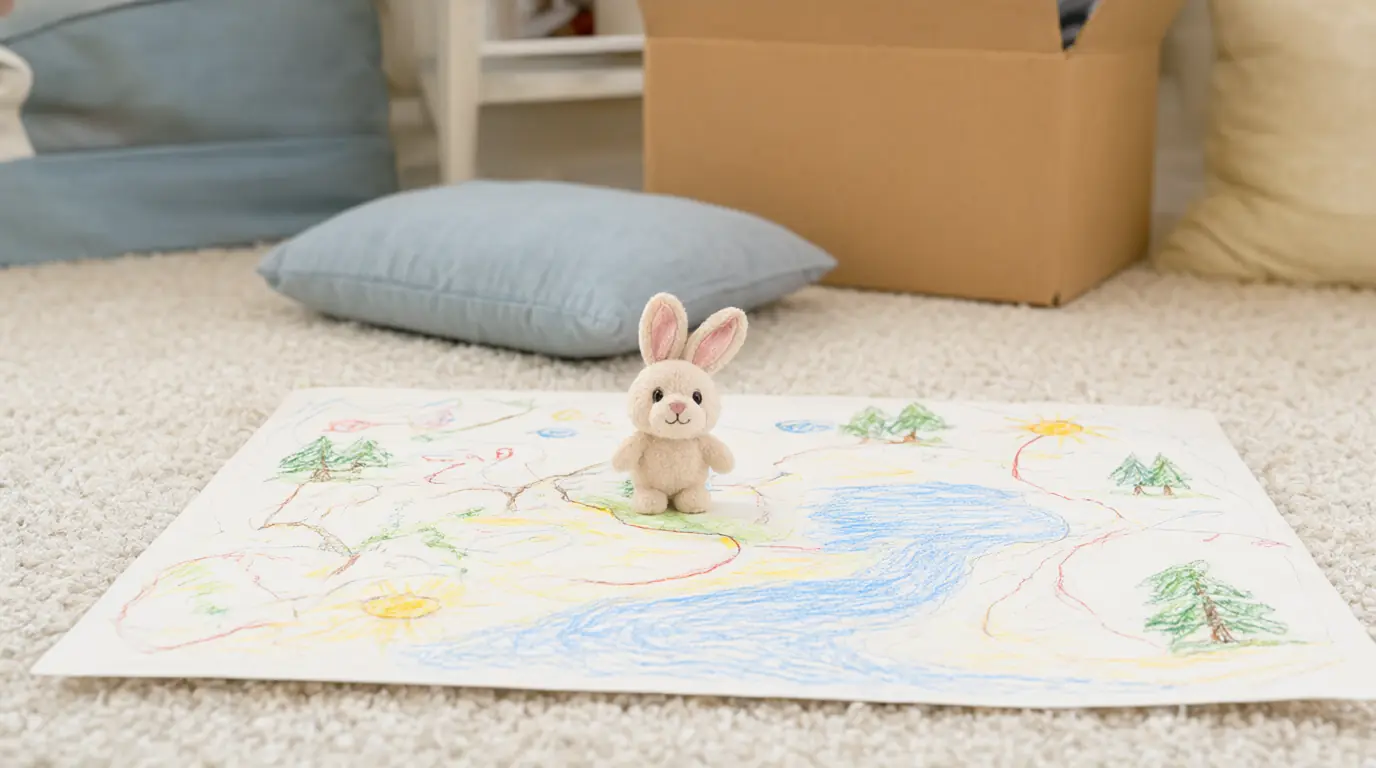
Make it your own: A two-year-old can move the toy every time you say the word, with no other rule. Five- and six-year-olds can hold two clue words, one for moving and one for stopping. If listening is hard, pair each clue with a hand gesture.
Drumbeat freeze
Sound gives the pause a shape: while the drum is tapping, feet are moving; when the tapping stops, everything freezes. Children who ignore a spoken instruction often respond to a rhythm, and the length of each pause can be stretched a second at a time. An upturned pan works as well as a drum.
You’ll need
- An upturned pan, a plastic tub or a drum
- A wooden spoon or a soft mallet
- An open floor with space to step and stand still
How to do it
- Tap a slow, steady beat and walk around the room while the tapping continues.
- Stop tapping and stand still with your child, waiting for the echo of the last tap to fade.
- Start again after a few seconds, so your child learns that stopping never ends the game.
- Make each pause one tap longer than the last, without saying how long it will be.
- Invite your child to hold the spoon and set the beat while you move.
- Try a soft tap for tiptoeing and a loud tap for marching.
- Finish by putting the spoon down together and sitting for a moment.
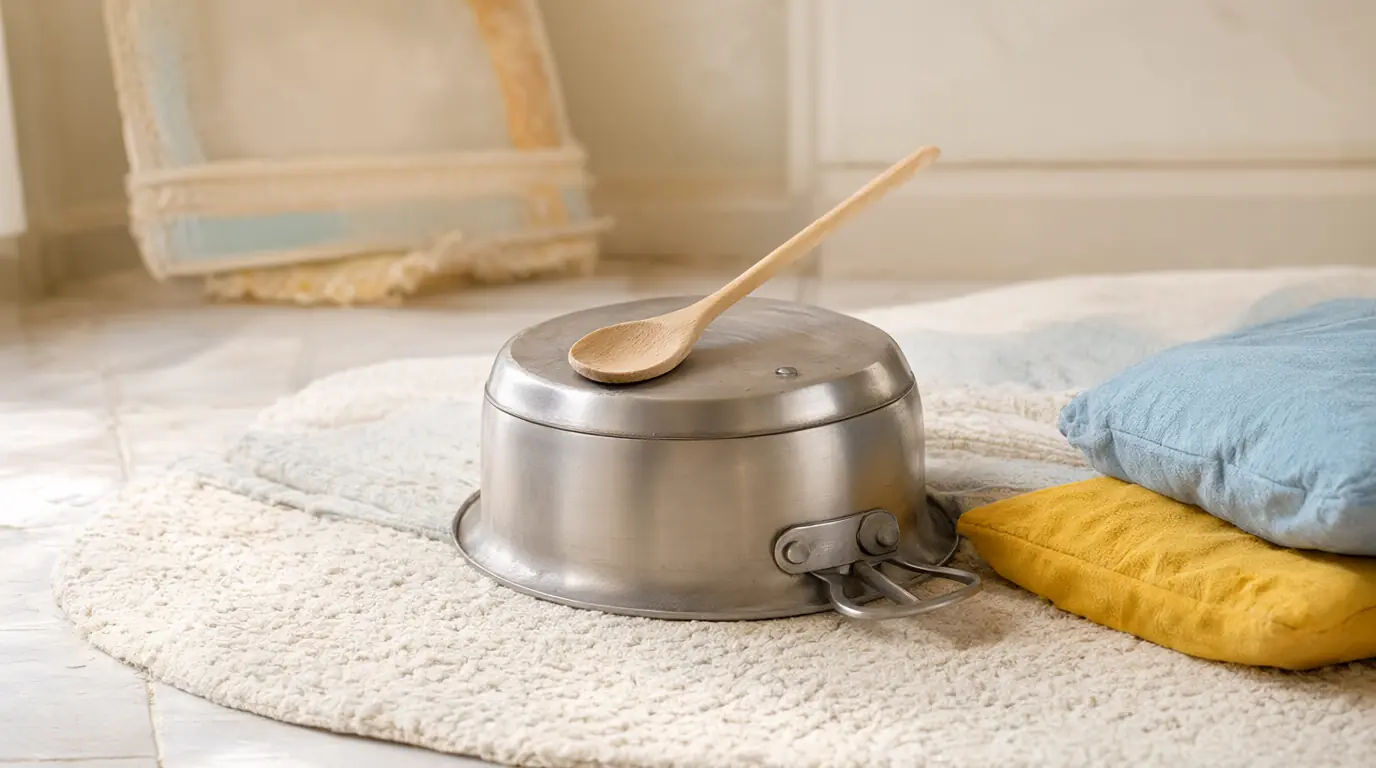
Make it your own: Younger children can clap instead of walking, so the pause only involves hands. Older children can choose a movement for each beat pattern, or freeze in a shape they invent. Keep the room clear of sharp corners and let anyone sit out for a round.
Make it work for your family
If a child keeps moving through the pause, shorten the pause rather than repeating the rule. Count to two and stop, then build up to five. Some children need to see the signal and hear it at the same time, so say 'stop' as you hold up the red card; others do better with a hand on the shoulder. Play when everyone is fed and rested, since pausing is hardest at the end of a busy day, and keep sessions to about five minutes.
Stop the round before interest fades, and finish on a pause so the game ends calmly. If your child asks for another turn, continue tomorrow. These are ordinary games, not a treatment for any condition; if you are worried about attention, listening or behaviour over time, talk to your health visitor or doctor. For more ideas that build the same skill, try these attention games that invite looking and listening or a few gentle noticing activities.

Parents also ask
At what age can children play stop-and-go games?
Most children join in from around two or three, in a simple form with a picture card and an adult copying the movements. Three- and four-year-olds often manage a spoken cue and a longer pause, while five- and six-year-olds can hold two signals at once. Follow your child's interest rather than the age.
What if my child refuses to stop when the signal comes?
Shorten the pause and make the signal bigger: say the word while showing the card. Stopping mid-game is hardest when a child is excited, so try the round at the start of play rather than at the end. If it does not work today, leave it and return another day.
How long should a stop-and-go game last?
About five to ten minutes is usually enough for young children, with a clear finish on a pause. Several short rounds across a week help more than one long session. If your child asks for another turn, that is a good sign the game is still fun.
Choose materials and activities that suit your child, supervise as needed and adapt the ideas to their interests and abilities. About our editorial approach