Weebou Editorial Team
 9 min read
 In this article
A little preparation
Start by choosing one area to notice rather than trying to cover everything. For a week, watch what your child returns to at home: the same pretend game, a pile of stones, a drawing on the back of an envelope. Note when it happens and how long it lasts. That small record, kept on your phone or the back of a shopping list, gives you something concrete to discuss instead of a vague impression.
Then ask your child's educator how that interest appears in the setting, and what children are exploring in general: talk, number, making, movement, friendships and self-care. Settings differ in curriculum and routine, and a child may behave quite differently in a group. Keep questions open and specific, and treat the answers as a shared description rather than a score. If you are worried about development, access or support, raise it with the educator and, where relevant, your health visitor or another qualified professional. Getting ready for kindergarten covers a similar conversation from another angle.
What to know and try
Talking, stories and pretend play
Language grows fastest when it is doing something: retelling what happened at the park, ordering from a pretend café, or arguing about whether the dragon is friendly. Children who hear and use rich language in real exchanges build vocabulary, sentence structure and the turn-taking that later supports reading. Listen for how your child's educator invites talk, then copy that low-pressure style at home.
How to do it
- Ask your child's educator how talking is built into the day, not just into story time.
- At home, retell one small event together, taking turns to add the next detail.
- Leave a gap after a question and count to five silently before filling it.
- Set out two toys and a box, then invite a scene rather than a finished story.
- Treat gestures, drawings and home-language words as real contributions.
- Read the same favourite book three times and let your child correct your mistakes.
Make it your own: With a child who uses few words, offer two choices and accept a point or a nod. With an older child, ask what happened just before and just after, or invent a different ending for the same story.
Maths hidden in real jobs
Counting aloud is only a small part of early maths. Setting the table for four, pairing socks, cutting a sandwich in half or working out whether the tower is taller than the box all use number, pattern and comparison for a reason. Children remember these ideas because the answer matters to them, not because they were asked to recite it.
How to do it
- Ask what number ideas appear during the day: tidying by type, counting children, comparing sizes.
- Give one real job at home that needs counting or matching, such as a cup for everyone.
- Use the words more, fewer, same, half, heavier and shorter while you work.
- Let your child check the result themselves instead of telling them it is wrong.
- Ask them to show you one maths moment they enjoyed at preschool this week.
Make it your own: Younger children can match one cup to one place. Older children can plan for a missing person, estimate how many spoons fit in a jar, or record the count with tally marks.
Learning to join play and ask for help
A large part of preschool is social: approaching a group, offering a piece, waiting for a turn, saying no, and finding an adult when something is too hard. These are skills rather than personality traits, and they are practised slowly. Ask how adults in the setting help children enter play, and use the same wording at home so the phrases feel familiar.
How to do it
- Find out what children are taught to say when they want to join in.
- Practise one short phrase at home with toys: Can I have a turn when you are finished?
- Name your own need for a break out loud so the idea becomes normal.
- Set up a two-person game with a clear turn and let your child run it.
- Notice one patient or generous moment and describe it plainly.
Make it your own: A child who finds groups hard may prefer to start with one friend or a parallel activity nearby. An older child can help plan a game and decide how to include someone who arrives late.
Marks that mean something
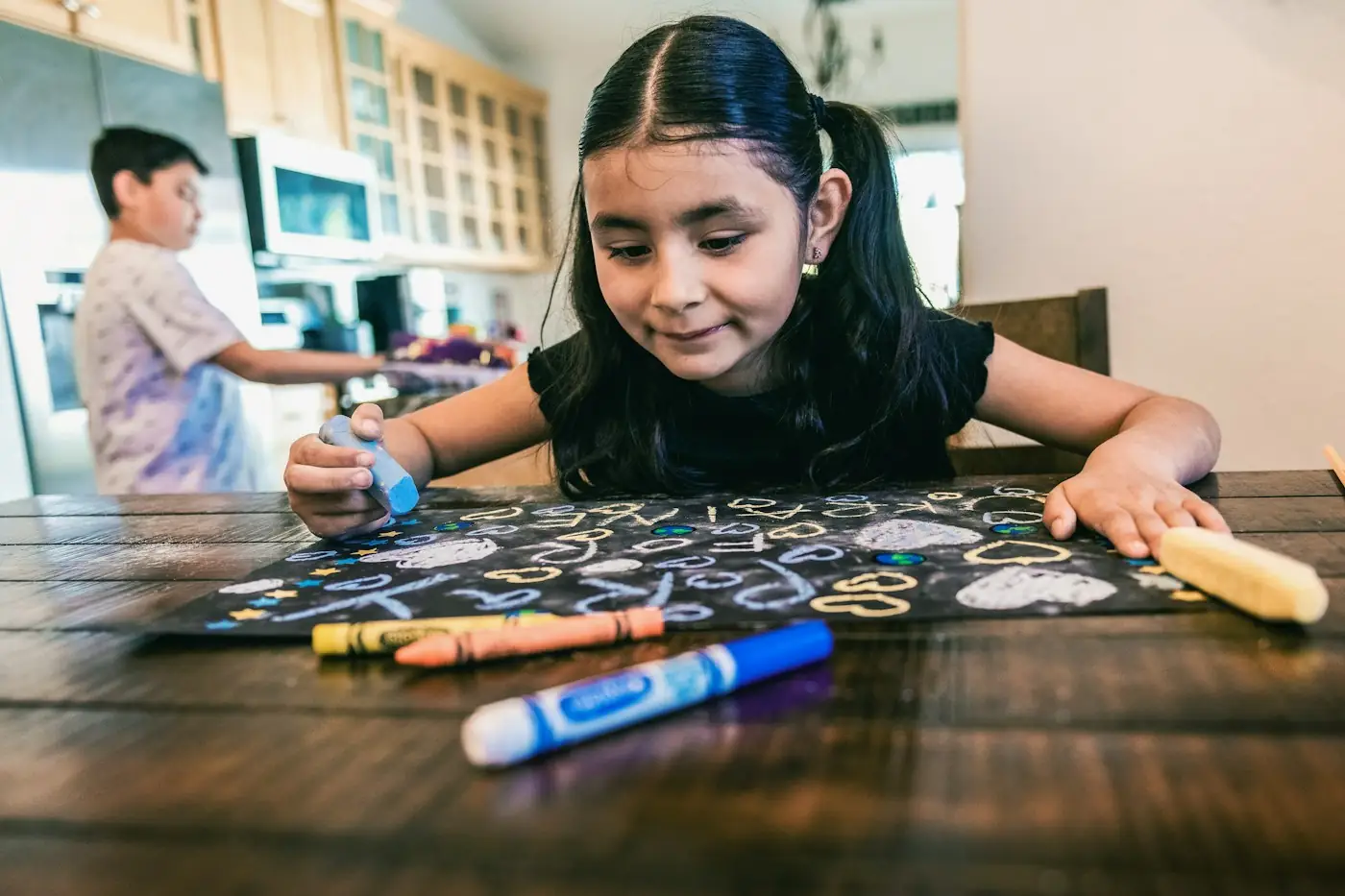
Before letters, children draw signs that stand for things: a circle for a person, a row of zigzags for a fence, a pretend shopping list. This is early writing, and it develops through purpose rather than practice sheets. Ask what mark-making materials are available, then offer the same at home. For more, try these writing activities for preschoolers.
How to do it
- Ask whether children write for a reason, such as labels, lists, signs or messages.
- Keep thick pencils, crayons and scrap paper within reach rather than in a cupboard.
- Write your child's words underneath their marks and read them back.
- Make a real list together before shopping and let your child hold it.
- Try big movements first: chalk on paving, or a brush and water on a wall.
Make it your own: If your child avoids a pencil grip, start with chalk, paint or sticks in sand. If they love detail, offer a small notebook and a job that needs writing, such as a label for their bedroom door.
Big movement and outdoor noticing
Running, climbing, balancing, carrying and digging build strength and coordination, and they also teach children to judge risk. Add the noticing that happens outdoors: a snail trail, a puddle that shrank, a leaf that changed colour. Settings usually plan for both. At home, a short walk with one question can offer more than an organised class.
How to do it
- Ask how much of the day happens outdoors and what children are allowed to climb or carry.
- Take a short walk with one noticing job, such as finding three different leaves.
- Let your child carry something genuinely useful, like a bag of apples or a watering can.
- Offer a balance line: a plank on the ground, a low kerb or a row of cushions.
- Stop and look up, down and behind before heading home.
Make it your own: For a cautious child, stay close and let them choose the height. For a child who seeks movement, add a heavier carry, a longer route or a job that needs both hands.
Small acts of independence
Putting on a coat, opening a lunchbox, wiping a spill and asking to use the toilet are real learning. They combine memory, sequencing, fine motor control and confidence. Educators often build long pauses into routines so children can try first. At home, the same pause is the useful part: wait a little longer than feels comfortable before stepping in.
How to do it
- Choose one routine your child could partly own this week: shoes, coat, cup or bag.
- Break it into steps and show it once, slowly, without a running commentary.
- Put a hook or basket at your child's height so the job is possible.
- Let them struggle for a few seconds before offering the smallest help.
- Describe what worked: You got the second sleeve on by yourself.
Make it your own: Younger children can manage one step, such as pulling off a Velcro shoe. Older children can pack their own bag from a picture list and check it at the door before you leave.

Make it work for your family
Resist turning this into a checklist. Children rarely develop evenly: a child who talks in long sentences may still need help with a coat, and one who counts to twenty may find groups hard. If a concern persists across months and across settings, write down what you see, when it happens and what helps, then share it with the educator rather than testing your child at home. One observation is a snapshot, not a verdict.
Keep the support small and repeatable. Ten minutes of a game your child chose beats an hour of adult-led activities, and a child who says no is giving you useful information. If preschool is new, expect a settling period and keep home calmer for a few weeks. For the reading side, see when do kids learn to read, and for low-prep ideas at home, try these preschool activities at home.

Parents also ask
What should a child know before starting preschool?
Nothing specific is required. Settings expect children who are still learning to share, speak, use the toilet and manage a coat. Practise small routines such as opening a lunchbox, saying goodbye and asking an adult for help, and tell the educator what comforts your child.
What do children actually learn in preschool?
Alongside early literacy and maths, children practise language, turn-taking, movement, making, self-care and solving small problems with others. Most of this happens inside play and daily routine rather than in formal lessons, which is why it can look quite unlike schoolwork.
How can I help my child learn at home?
Follow what your child is already interested in. Talk through everyday jobs, read the same book again, keep paper and crayons within reach, and give one small job they can finish alone. Short, repeated moments with your attention do more than a full timetable of activities.
Sources & further reading
Explore these primary sources for further context on this topic.
Choose materials and activities that suit your child, supervise as needed and adapt the ideas to their interests and abilities. About our editorial approach