Weebou Editorial Team
 10 min read
 In this article
A little preparation
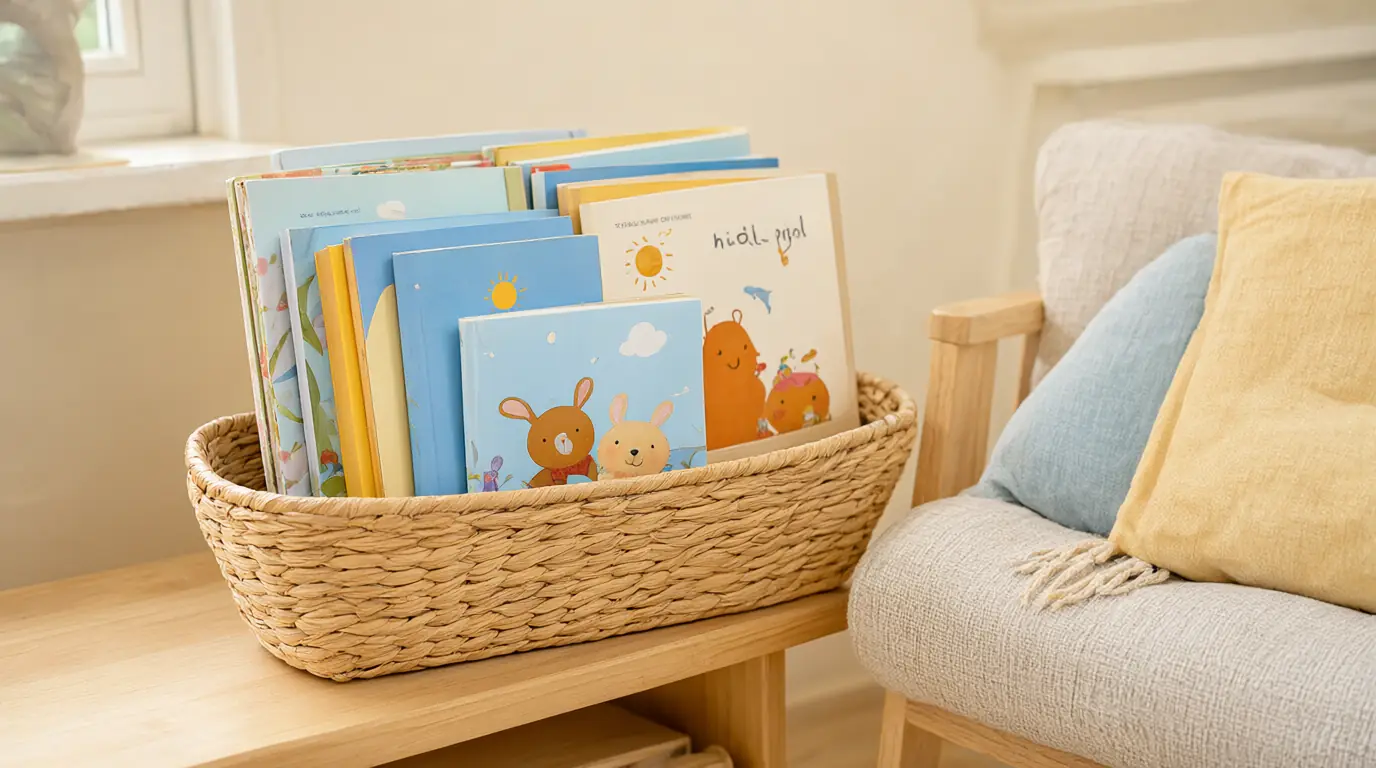
Pick a spot in the room where a shallow basket or a low shelf can hold six to ten books with their covers facing out, so your child can browse without asking for help. Covers-out display does far more for choosing than a packed, spine-out shelf. Keep the books where the family already sits — beside the sofa, next to the kitchen table — rather than in a separate reading corner that nobody uses. Five unhurried minutes at a regular time is enough to start.
Build variety into the basket: a board book, a picture book you both enjoy, a non-fiction title about something your child notices, a book of rhymes and one or two library borrows. Swap two or three titles every week or so, but leave firm favourites in place — returning to a known book is part of how children learn a story. Check second-hand paperbacks for loose staples or peeling laminate before they reach a child who still mouths things. If you are unsure what to expect at each age, this look at when children learn to read describes the steps without turning them into deadlines.
What to know and try
A book basket at your child's height
A basket or low shelf at your child's shoulder height turns books into something they can pick up without asking. Front-facing books let a child recognise a cover from across the room and choose by picture rather than by title, which is exactly how a pre-reader can decide. Rotating a few titles keeps the choice fresh without hiding old favourites.
 You’ll need
- A shallow basket or a low shelf
- Six to ten picture books with sturdy covers
- A spot beside where your family already sits
How to do it
- Clear the lowest shelf or a patch of floor beside a chair your family already uses.
- Stand the books with their covers facing out, spine down, so the pictures are visible at a glance.
- Check that your child can reach the basket while sitting down, without climbing.
- Keep two or three well-loved books in place and swap the rest every week or two.
- Tape torn pages before the tear grows, and take out books your child has moved past.
- Ask your child to put one book back when they choose a new one, so the basket stays browsable.
Make it your own: In a shared room or a small flat, use a fabric bag or a plastic crate that can be lifted out of the way. Older children can sort their own basket by topic or size; toddlers will mostly empty it, which is fine.
Read the pictures before the words
Before you read a word, ask your child what they can see. Naming what is happening in an illustration asks a child to build meaning from images, which is real reading work. There is no wrong answer, so a hesitant child can contribute without risking a mistake. You can still read the words afterwards, or let their version stand.
How to do it
- Open the book at a picture-rich page and ask, 'What can you see here?'
- Wait through the silence, and give a clue only after a long pause.
- Repeat their words back with one detail added, rather than correcting them.
- Ask what might happen next, then turn the page and find out together.
- Read the printed words afterwards if your child wants them, or stop at the pictures.
- Finish while the page still interests them and close the book.
Make it your own: Toddlers may only point; name whatever they point at. Older children can hunt for a letter they know, or tell the whole story from the pictures before you read a single line.
Follow their interests into non-fiction
Non-fiction often suits young children better than stories because it can be dipped into and left. A child who loves diggers, dinosaurs or the moon will happily return to a book full of photographs and labels. Look for titles with clear pictures and short captions, and let your child choose the pages. Talking about a diagram uses the same vocabulary as these picture vocabulary games, with a book in your lap.
How to do it
- Listen for the topics your child repeats in play, then look for a book about exactly that.
- Choose non-fiction with one clear idea per page and photographs rather than dense text.
- Let your child open it wherever they like; you do not need to start at the beginning.
- Name what is in the picture, then add one fact you are sure is true.
- Leave the book out for a few days and see whether it is picked up again.
- Note what your child asks about and look for the answer together next time.
Make it your own: Children who need to move can act out a page — stomp like the dinosaur, reach up for the moon. Older children can compare two books on the same topic and decide whose pictures make it clearer.
Stop while it still feels good
Ending on a high note teaches a child that reading is something to come back to. A whole book is not the goal; a few shared pages are. If you stop while interest is still there, the next session begins with a child who wants more rather than one who remembers a struggle. Say clearly that you are pausing.
How to do it
- Decide in advance that one page, one poem or one chapter counts as a complete session.
- Watch your child's body: wriggling, looking away or flipping pages fast usually means stop.
- Say the ending out loud — 'That is our reading for now' — so it feels finished, not abandoned.
- Leave the book open or back in the basket so it can be picked up again.
- If you must stop mid-story, mark the page and say when you will return to it.
- Never turn the last page into a test of what your child remembered.
Make it your own: Younger children may manage only one picture; older ones can choose the stopping point themselves. If your child always asks for one more page, agree on a number before you begin.
Let your child catch you reading
Children copy what they see far more than what they are told. When you read a recipe, a bus timetable, a message or a manual and say what the words helped you do, reading becomes a useful adult skill rather than a school task. Keep it brief and genuine; a running commentary turns a quiet moment into a lecture.
How to do it
- Read something in front of your child at least once a day, even for a minute.
- Say out loud what the text is doing: 'This says the oven needs twenty minutes.'
- Keep cookbooks, magazines and leaflets within reach, not only children's books.
- Ask your child to hold the page or find a picture while you read.
- Show them a message or a shopping list that matters to the family.
- Let them see you choose a book for pleasure, and say why you picked that one.
Make it your own: Toddlers mainly need to see the habit; older children can be given their own list to check at the shop. If you read mostly on a screen, say what you are reading so the skill stays visible.
The tenth reading of the same book
Re-reading is not a lack of progress; it is how young children master a story. On the tenth reading they know what comes next, which lets them notice new details, finish your sentences and feel in charge. Instead of steering them towards something new, join in and let the familiar text do its work.
How to do it
- Say yes to the same book again, even when you would rather not.
- Second time round, pause before a repeated line and let your child finish it.
- Third time, point out a detail nobody has mentioned yet.
- Ask what a character might be thinking on a page you both know well.
- Try a different voice for one character and see whether your child notices.
- Keep the book in the basket rather than putting it away once it feels done.
Make it your own: A child who has memorised a book is ready to read it to a toy or a younger sibling. Older children can retell the story in their own words or draw a new ending for it.

Make it work for your family
If story time regularly ends in tears, the timing is usually the problem rather than the book. Try a different slot — a poem at breakfast, a book in the pushchair, ten minutes after lunch — and see which one your child settles into. Sitting still is not the same as listening, so let your child stand, build or draw while you read. A book that is too long can be shortened: paraphrase the middle pages, read only the speech bubbles, or stop at a cliff and finish tomorrow.
Some children listen better with something in their hands — a soft toy, a small car, a piece of string. Keep the routine short and repeatable, and put a book your child dislikes away for a month before trying it again. Ask at your library for titles that match what your child already plays at. Above all, treat reading together as a habit built over months, not a skill to be checked. Children who are already sounding out words can talk about a story with these simple comprehension questions.

Parents also ask
How do I encourage my child to read if they never sit still?
Let them move while you read. Many children listen better while building, drawing or walking about, and insisting on a still body can end the story altogether. Keep sessions to a few minutes, choose books with rhythm and repeated lines, and try different times of day. A child who wanders back to hear the funny part is still listening.
Should I read the same book over and over?
Yes, if your child asks. Re-reading lets them predict what comes next, finish sentences and notice details they missed the first time, which builds vocabulary and confidence. Keep a few favourites in the basket and rotate other titles around them. If you are bored, change your voice for one character rather than swapping the book.
At what age should I start reading to my child?
You can start in the first year with board books, songs and simple pictures, and most children enjoy being read to long before they read independently. There is no deadline for that step; many children recognise their name and common signs around four or five, then take longer with whole sentences. Follow interest rather than a timetable, and speak to a professional if you have specific concerns.
Sources & further reading
Explore these primary sources for further context on this topic.
Choose materials and activities that suit your child, supervise as needed and adapt the ideas to their interests and abilities. About our editorial approach