Weebou Editorial Team
 7 min read

 In this article
A little preparation
Pick a small set of pictures or objects that your child already knows a little about, plus two or three new ones. Ten cards is plenty. Clear photographs of single objects work better than busy scenes, and family photos are excellent because children already have stories attached to them. Put the pictures in a basket or a shallow tray so that they can be seen and chosen easily.
Sit at the same level as your child and say the new words slowly and clearly, using them in short sentences: 'This is a ladle. We stir soup with a ladle.' Leave pauses so your child can try a word, a sound, a gesture or a point, and accept whichever they offer. Aim for about ten minutes, and stop before interest fades. Repetition is helpful, so keep the same cards for a few days and swap one or two for new ones rather than changing the lot. If a word is difficult for your child to say, say it back correctly in the next sentence without asking them to repeat it.
Ideas to try together
Picture shopping
A pretend shop gives words a real purpose: your child collects what the customer asks for. Naming food, household items and clothes in a shop setting builds categories and helps children link a word to its use. It also gives you a natural chance to model phrases such as 'please' and 'thank you'.
 You’ll need
- 6 to 8 picture cards of food or household objects
- A small basket or toy trolley
- A table or low shelf as the shop counter
- A toy purse or paper coins
How to do it
- Lay the cards face up on the counter and name each one.
- Say a request, such as 'I would like the apple and the bread, please'.
- Let your child find the two cards and place them in the basket.
- Check together by naming each card as you take it out.
- Swap places so that your child is the customer and you are the shop keeper.
- Finish by 'paying' with paper coins and saying thank you.
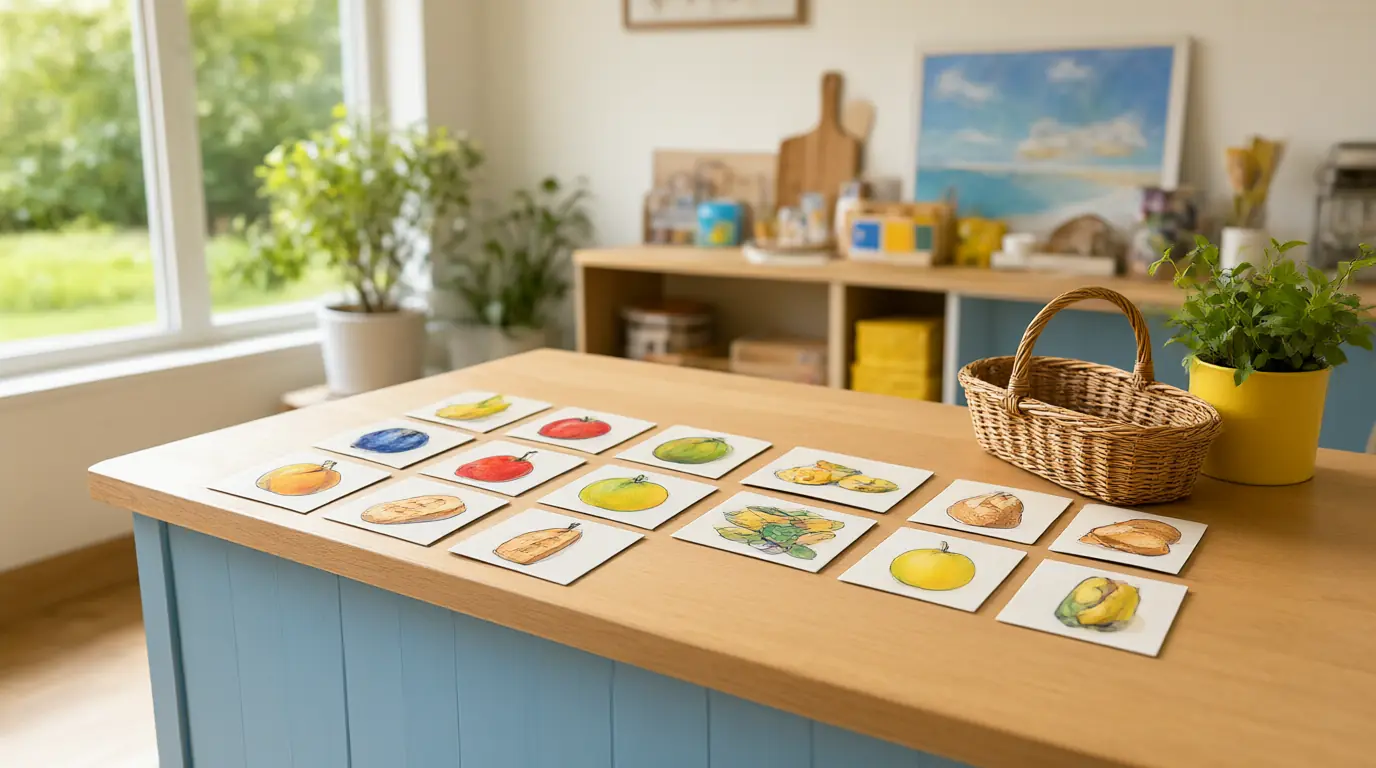
Make it your own: Younger children can fetch one item at a time. Older children can follow a three-item shopping list or describe an item without naming it, such as 'it is yellow and you peel it'.
Photo storyteller
Family photos are rich in vocabulary because children care about the people and events in them. Asking about actions rather than just names invites verbs and descriptive words. Children often add details you would not have noticed, and that gives you a chance to introduce new words naturally.
You’ll need
- 5 to 6 printed family photos or a photo album
- A cushion to sit on
- A pencil and paper to note new words
How to do it
- Choose a photo of a place your child remembers, such as the park.
- Describe an action you can see: 'She is climbing the slide.'
- Pause and invite your child to add something they remember.
- Introduce one new word, such as 'wobbly' or 'splashing', and use it twice.
- Ask which picture they would like to look at next.
- Write one or two words on paper to display on the fridge.
Make it your own: Younger children can point to people and name them. Older children can tell what happened before or after the photo.
Which one belongs?
Sorting pictures teaches categories and descriptive words, and encourages children to explain their thinking. Often more than one answer is possible, which is good for conversation. Accepting a child's reasoning helps them feel confident to try again.
You’ll need
- 3 picture cards for each round, 2 from one group and 1 from another
- A tray or cloth to lay them on
- A few extra cards for later rounds
How to do it
- Lay out three cards, such as a cat, a dog and a spoon.
- Ask, 'Which two go together?'
- Listen to your child's reason and repeat it back: 'The cat and dog are animals.'
- Ask if there is another way to group them, and accept any sensible answer.
- Try a new set of three.
- Let your child build a set of three for you to solve.
Make it your own: For younger children use very different groups, such as animal and food. Older children can sort by colour, size or where the object is found.
Action card charades
Acting out verbs gives children a physical way to remember them. Words such as 'yawn', 'tiptoe' and 'hug' stick when children feel them in their bodies. The matching element keeps it a game rather than a test, and your child can be the actor or the guesser.
You’ll need
- 6 picture cards showing clear actions
- A cushion or mat
- A basket
How to do it
- Lay out the cards and name each action together.
- Choose one in secret and act it out.
- Ask your child to point to the card that matches.
- Say the word together and repeat the action.
- Swap roles and let your child act while you guess.
- Play again with a silly twist, such as acting like a sleepy robot.
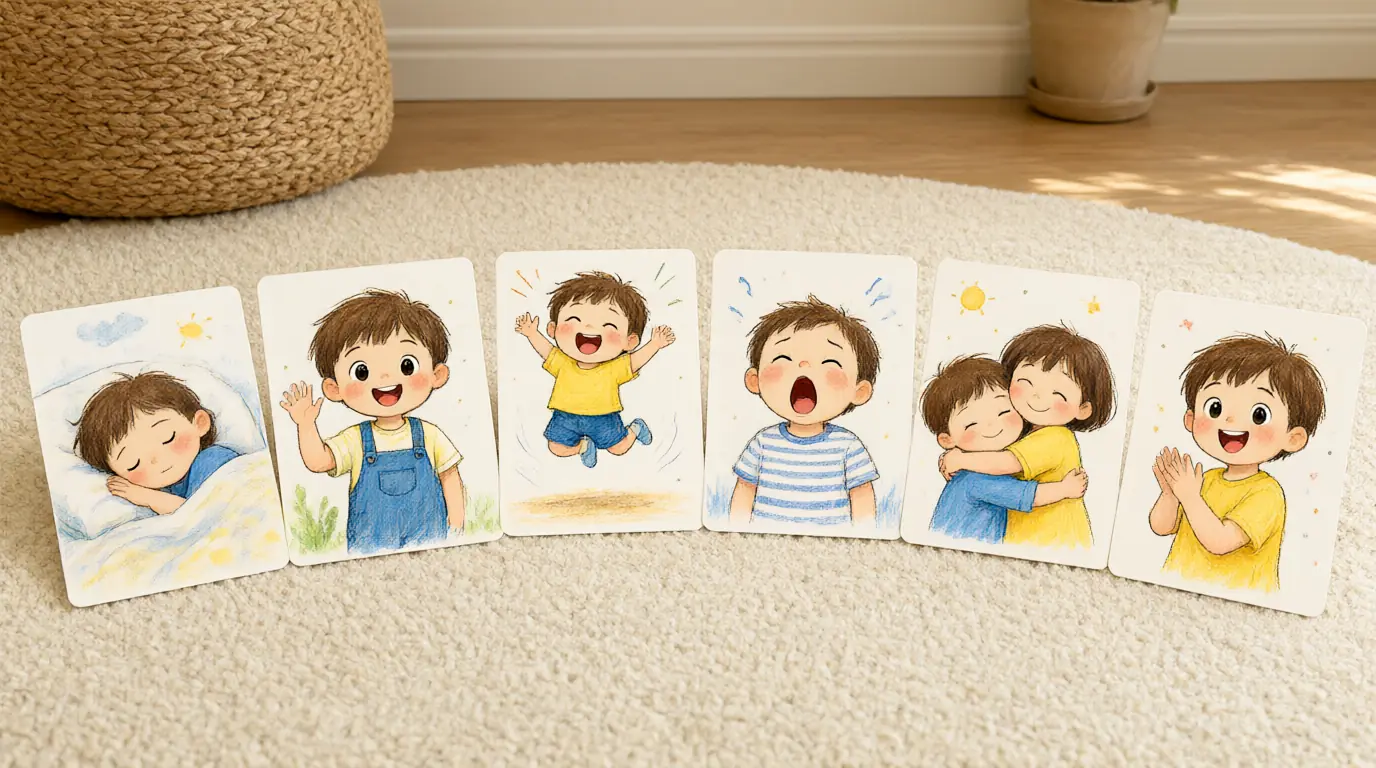
Make it your own: Young children can act first and simply enjoy being copied. Older children can add adverbs, such as 'slowly' or 'quietly'.
House word hunt
A hunt around the home lets children match words to real objects. They carry a few things back and talk about what each one does. It is a good way to widen everyday vocabulary beyond toys and snacks, and a child's interest in a new object often shows what they want to learn.
You’ll need
- A small basket or bag
- A list of 4 pictures of safe household items, such as a spoon, a sock, a cup and a towel
- A pencil to tick each one
How to do it
- Draw a simple picture of each item on a card.
- Show your child the first card and ask where it might be.
- Walk together to find the real object and bring it to the basket.
- Talk about what it does and describe its colour or texture.
- Tick the card and move on to the next.
- When all are found, lay them on the table and name them together.
Make it your own: Younger children can find two items. Older children can find an object that begins with a given sound or that has a given feature, such as 'something soft'.

Make it work for your family
A new word needs to be met in several real situations before it sticks. When your child learns 'ladle', hand them the real one at supper, point to it in a picture book and mention it when you wash up. A few meaningful encounters in a week do more than a long flashcard session.
Try not to quiz. Instead of 'what's this?' say what you see and wait: 'Look, a red bucket.' Children who are learning more than one language can use any language they like for a word, and you can add the other. If you are worried about your child's speech or language development, speak with your health visitor or a speech and language therapist. For more everyday talk games, see speech and language games, or practise word recognition in the Weebou words game.

Parents also ask
How can I help my child learn new words?
Talk about what you are doing together, use new words in short sentences, and repeat them in different settings. Picture books, family photos and real objects help. Pause to give your child time to answer in any way they can.
How many new words should I teach at a time?
Two or three new words alongside several familiar ones is plenty for a short session. Children learn best when words come up again naturally over several days rather than being crammed into one go.
What if my child will not say the word?
Accept pointing, gesturing or signing as a valid reply, and model the word in a sentence without asking for a repeat. Take pressure off and try again another day. If you are concerned about language development, talk to your health visitor or a speech and language therapist.
Sources & further reading
Explore these primary sources for further context on this topic.
Choose materials and activities that suit your child, supervise as needed and adapt the ideas to their interests and abilities. About our editorial approach