Weebou Editorial Team
 In this article
A little preparation
Start with a calendar and a pencil rather than a worksheet. Spread the calendar flat where your child can reach it, mark this year's November, and keep a couple of library books and a sheet of paper nearby for questions you cannot answer yet. Fifteen minutes at a time is plenty; the facts below are written to be read aloud in a few sentences each, with your child free to wander off and come back. If you plan to use them at the table, choose two or three beforehand so the meal does not turn into a lesson.
Be straightforward about what is known and what is not. Historians work from a small number of written accounts and from Native oral histories, so phrases like 'we know that' and 'some people think' mean different things and are worth keeping apart. Keep descriptions of the past general rather than graphic, and let your child set the depth. If your family or your child's classmates are Wampanoag or from another Native nation, do not ask them to explain their culture on the spot; read and learn alongside them instead.

Questions to explore together
Why it is always a Thursday in November
The date is a rule rather than a fixed day, which makes it a satisfying thing for a child to work out. Once you have counted the Thursdays together, the holiday stops being a vague 'sometime in November' and becomes a point on a line your child can track. It also explains why the date shifts every single year.
How to do it
- Thanksgiving in the United States falls on the fourth Thursday of November, so the date changes each year.
- In 2026 it is 26 November; in 2027 it will be 25 November.
- Count the Thursdays in November together: the 5th, 12th, 19th and 26th in 2026. The fourth one is the holiday.
- Canada's Thanksgiving follows a different rule: the second Monday of October.
- The fourth-Thursday rule was settled by Congress in 1941, after a few years when states used different Thursdays.
- In the UK, harvest is usually marked with a harvest festival service and donations of food rather than a national November holiday.
- Some families cook on the Saturday instead, so the official date and your family's date are not always the same.
Make it your own: Younger children can simply find and stamp every Thursday in November. Older ones can work out the rule by checking three years in a row, then predict next year's date before you look it up.
Six dishes and where they came from
Food is the easiest way into history because it is already on the table. Each familiar dish carries a migration story, and a few of them travelled further than the people sitting around them. This turns the meal into a map your child can point at.
How to do it
- Turkey is native to North America. Wild turkeys were domesticated long ago in what is now Mexico and later travelled to Europe and back.
- A written account of the 1621 gathering mentions wild fowl, but nothing names turkey; the centrepiece idea came much later.
- Cranberries grow in wet bogs and are native to North America. Wampanoag people used them for food and for dye long before anyone made a sauce.
- Corn, beans and squash were grown together by many Native nations, including the Wampanoag, in a planting often called the three sisters.
- Pumpkins are native to the Americas, but pumpkin pie became a standard holiday dessert only in the 1800s.
- White potatoes come from the Andes and sweet potatoes from Central America, so both travelled a long way to reach a modern plate.
- Green bean casserole was created in a soup company's test kitchen in the 1950s, which makes it younger than most grandparents.
- Plenty of tables include dishes with no link to New England at all: tamales, rice and beans, macaroni cheese, or a recipe carried from another country.
Make it your own: Younger children can sort pictures of the dishes into 'grows in the ground' and 'comes from an animal'. Older ones can pick one ingredient, find where it was first grown and trace the route it took.
How the holiday was actually made
Children often assume the holiday has run continuously since 1621. The surprise is that it is a nineteenth-century project, pushed through by an editor and a wartime president. That single fact makes the whole story easier to think about, because it shows that traditions are made by people, not handed down finished.
How to do it
- The 1621 event was a harvest gathering lasting several days, described in only a couple of short surviving accounts. Nobody there called it Thanksgiving.
- For more than two centuries the day was mostly local, with different dates in different states.
- Sarah Josepha Hale, a magazine editor, campaigned for a national holiday for decades, printing recipes, editorials and letters to presidents.
- In 1863, in the middle of the Civil War, Abraham Lincoln proclaimed a national day of thanksgiving, and the idea took hold.
- Congress fixed the fourth Thursday in 1941 after several years of confusion over which Thursday to use.
- The tidy 'first Thanksgiving' story, with a set menu and a shared table, was shaped much later in books, school pageants and advertising.
Make it your own: Younger children only need 'the holiday became official long after the 1621 gathering'. Older ones can compare a pageant version with a museum account and list what each one leaves out.
Native voices and the Day of Mourning
This is the part most simplified versions skip. Native people are not only figures in a 1621 story; they are neighbours, classmates and nations today, and the holiday means different things to different families. Handling that honestly is more useful to a child than a version with the difficult parts removed.
How to do it
- The Wampanoag are a living nation in what is now Massachusetts, with families, schools and a government today, not only a role in a story.
- Since 1970, Native organisers in Plymouth have held a National Day of Mourning on the same Thursday, to remember what followed colonisation.
- Other Native families mark the day with their own gatherings, food and thanks, and some do not mark it at all.
- Choose books and museum pages written or reviewed by Native authors, and check whether a nation is described in the present tense.
- Say plainly that the Wampanoag helped the newcomers survive, and that the years afterwards brought disease, land loss and violence, without dwelling on detail a young child cannot hold.
- Let your child ask why. 'Because people disagreed about land, and the newcomers had more power' is an honest place to start.
Make it your own: With younger children, keep it to 'Native people are still here and this land was theirs first'. Older children can read two accounts of the same event side by side and notice the different words each one chooses.
Gratitude that names the action
Asking a child to be thankful often produces a blank look, because gratitude without a person and an action is too abstract to hold. Naming who did what gives the feeling somewhere to land, and it works just as well in November as in any other month.
 You’ll need
- Strips of coloured paper, about 4 cm wide
- Pencils or crayons
- Tape or a glue stick
- A jar or a small basket
How to do it
- Ask 'who did something helpful for you this week?' rather than 'what are you thankful for?'.
- Help your child name the person and the action: 'Nan drove me to swimming even though she was tired.'
- Write each answer on a paper strip in your child's words, or let them draw the person instead.
- Tape the strips into a loop chain, or drop them into a jar to read out at the meal.
- Include people your child might not think of: the person who cooks, the bus driver, the child who shared a pencil.
- Add one of your own with a specific action, so your child hears what a real answer sounds like.
- Leave room for a child who does not want to say theirs aloud; a private strip in the jar still counts.
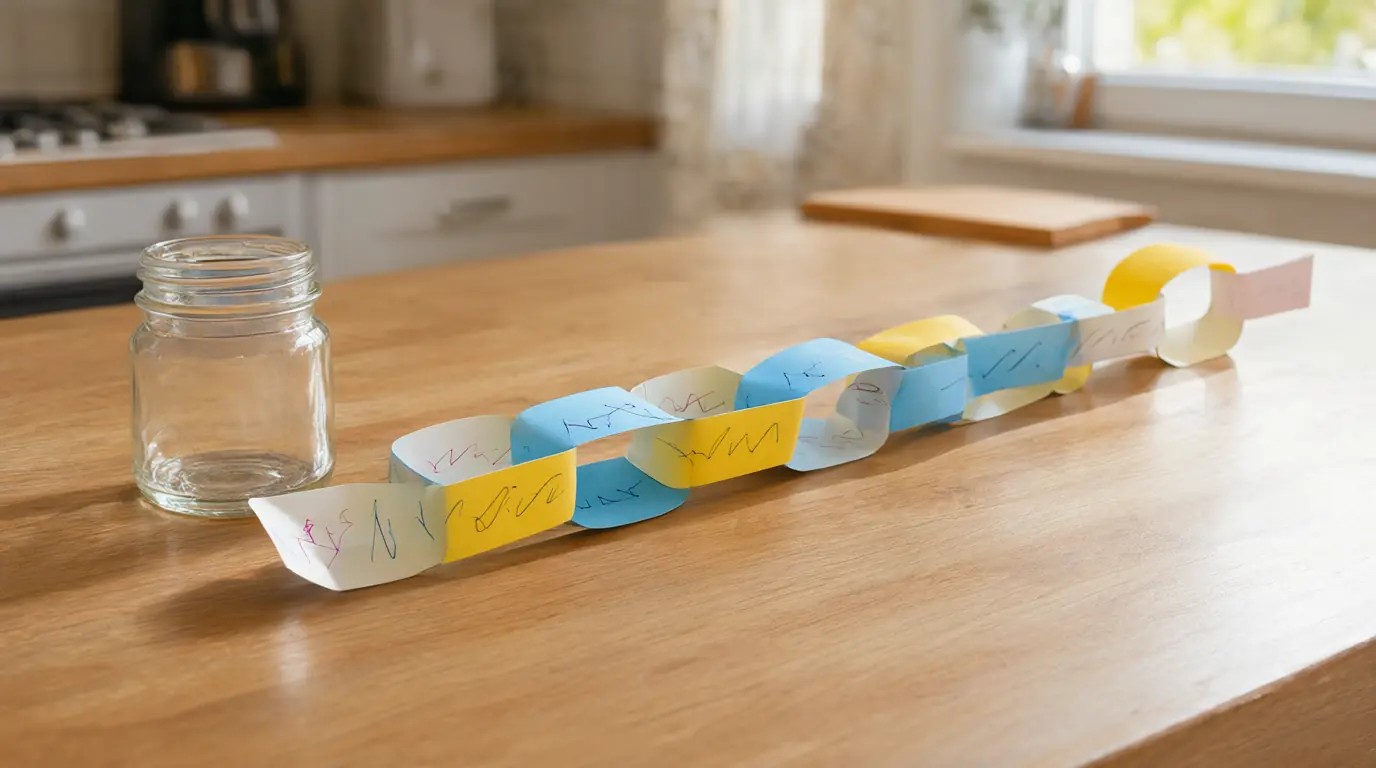
Make it your own: Toddlers can point to a photo of the person they mean and you write the words. Older children can write their own strips, or choose one person to thank with a short message or drawing.
Six table questions for the meal
A single round of 'what are you thankful for' rarely gets past the first answer. A handful of open questions keeps the conversation moving, works across ages, and gives quieter children a turn without putting anyone on the spot. Choose two or three rather than all six.
How to do it
- Which food on this table travelled the furthest to get here?
- Who is someone you did not see today but would like to tell about this meal?
- What is one thing that was hard this year, and who helped?
- If you could keep only one dish from this table, which would it be, and why?
- What is a small thing that happened this week that you want to remember?
- If you could invite one person from long ago to sit here, who would you ask, and what would you want to know?
Make it your own: Younger children can answer with a point or a single word, and you can build the sentence around it. Older ones can take turns asking the questions instead of answering them.

Make it work for your family
Expect some questions to land badly. A child may be upset by the mention of the Day of Mourning, or may repeat a pageant version you have just complicated. Both reactions are normal; keep your answer short and come back to it later. If a fact turns out to be wrong, say so plainly: 'I checked, and that detail isn't right.' Children learn more from watching an adult revise an idea than from a tidy explanation.
If your child wants to keep going, a few Thanksgiving activities for kids will carry the topic into making and playing, and these gratitude rituals turn the conversation into something you do rather than something you say. For a lighter table game afterwards, these Thanksgiving trivia questions keep the same facts in play. Stop while it is still enjoyable; the article will still be here next November.

Parents also ask
When is Thanksgiving in 2026?
Thanksgiving falls on the fourth Thursday of November, which in 2026 is 26 November. In 2027 it will be 25 November. The date moves because the rule counts Thursdays in the month rather than naming a fixed day.
How do you explain Thanksgiving to a young child?
Start with what your child can see: a calendar, a Thursday, food on the table. Then say that a long time ago people who had travelled far were helped by the Wampanoag, who already lived there, and that the holiday only became official much later. Keep it short and let their questions lead.
Was there turkey at the first Thanksgiving?
The surviving accounts of the 1621 gathering mention wild fowl and venison but do not name turkey. Turkey was plentiful and popular in the 1800s, when the holiday and its menu were being shaped, so it became the centrepiece then rather than in 1621.
Sources & further reading
Explore these primary sources for further context on this topic.
Choose materials and activities that suit your child, supervise as needed and adapt the ideas to their interests and abilities. About our editorial approach