Weebou Editorial Team
 7 min read
 In this article
A little preparation
Choose balls that suit the youngest child in the room and follow the age guidance on the product; as a rule of thumb, nothing should be small enough to fit in a toddler's mouth. Real marbles, beads and other small parts must be stored out of sight. Play on a clear floor or a rug, and put a towel at the end of every route so the balls slow down.
Build channels from stiff cardboard folded into a wide U and taped at the edges so there are no sharp corners. Keep ramps low, and ask everyone to stay beside, not in front of, a rolling route. Collect every ball after each round so no one steps on a stray one; tripping on a ball is the main hazard here. Plan about fifteen to twenty minutes, and change the activity whenever a child loses interest. If two children play, take turns releasing so that each has a clear role.

Ideas to try together
The wide channel run
A broad cardboard channel gives the ball a path and gives the child something to adjust. Changing the height of one end makes the ball faster or slower, which is the first lesson in how slopes work. The wide basket at the end gives a clear goal.
 You’ll need
- A sheet of stiff cardboard folded into a wide U-shape
- A large play ball
- A low stack of books or a cushion
- A wide basket or box
- Masking tape
How to do it
- Fold and tape the cardboard into a channel at least twice as wide as the ball.
- Rest one end on a low book stack and the other end beside the basket.
- Release the ball at the top and watch it roll into the basket.
- Raise the stack by one book and try again, noticing whether the ball is faster.
- Lower the stack by two books and see what happens to the ball.
- Ask your child which height they think works best.
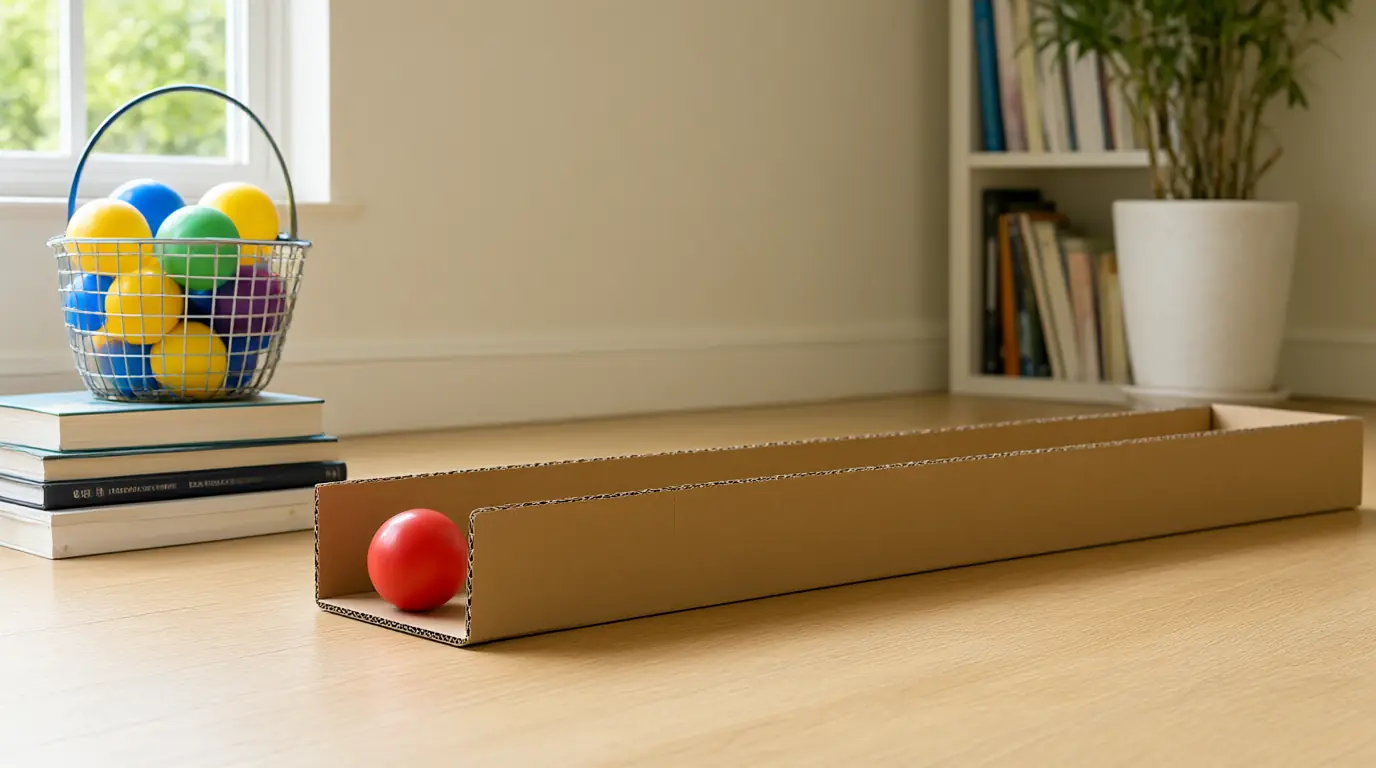
Make it your own: Keep the slope gentle for younger children so the ball moves slowly. Older children can aim to land in a specific basket or compare two channels.
Floor circle roll
A circle marked on the floor is a simple target that needs no equipment. Rolling toward it teaches children to judge distance and push with the right amount of force. Moving the starting line, not adding extra balls, keeps the game calm and fair.
You’ll need
- Floor tape or a hula hoop
- One large play ball
- A second piece of tape for a starting line
- A cushion to stop the ball
How to do it
- Make a circle on the floor with tape or lay out a hoop.
- Mark a start line about one metre away.
- Ask your child to roll the ball gently so it ends up inside the circle.
- Look at where it stopped and say whether it was too far, too short or just right.
- Move the line closer, further or to one side and try again.
- Take turns, and cheer for every attempt rather than only the hits.
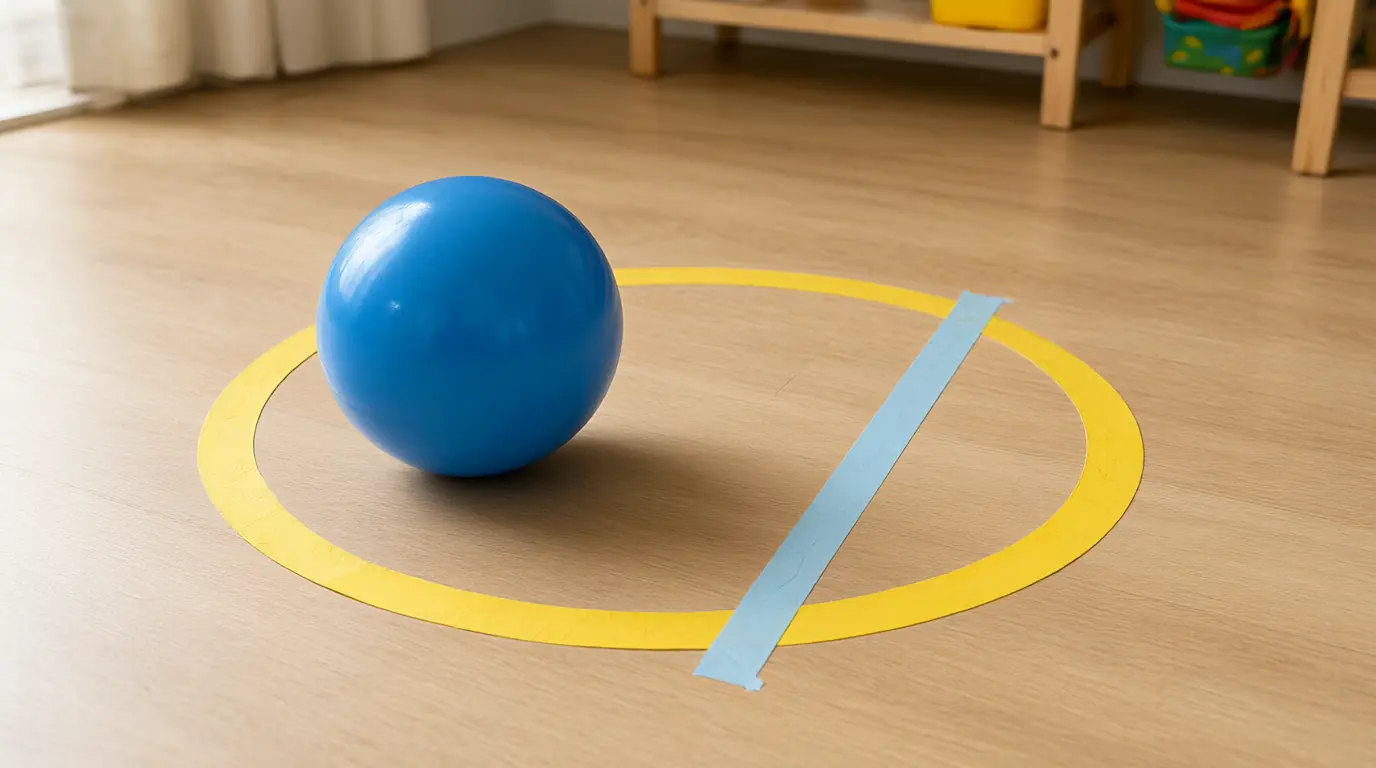
Make it your own: Start close for a younger child and make the target larger with a hoop. Older children can roll with their non-dominant hand or aim for a ring inside the circle.
Cardboard corner
Joining two channels with a turn makes the problem more interesting: the ball has to change direction. Children see that a gentle corner works while a sharp one sends the ball flying, and they adjust the join to fix it.
You’ll need
- 2 wide cardboard channels
- A large play ball
- Masking tape
- A large cushion as a stop
How to do it
- Lay the two channels so they meet at a gentle angle, like an L.
- Tape the join so the cardboard overlaps smoothly.
- Release the ball at the top and see whether it follows both channels.
- If it leaps out of the corner, curve the join or add a low side wall.
- Ask your child to decide what needs changing.
- Try a different angle and compare.
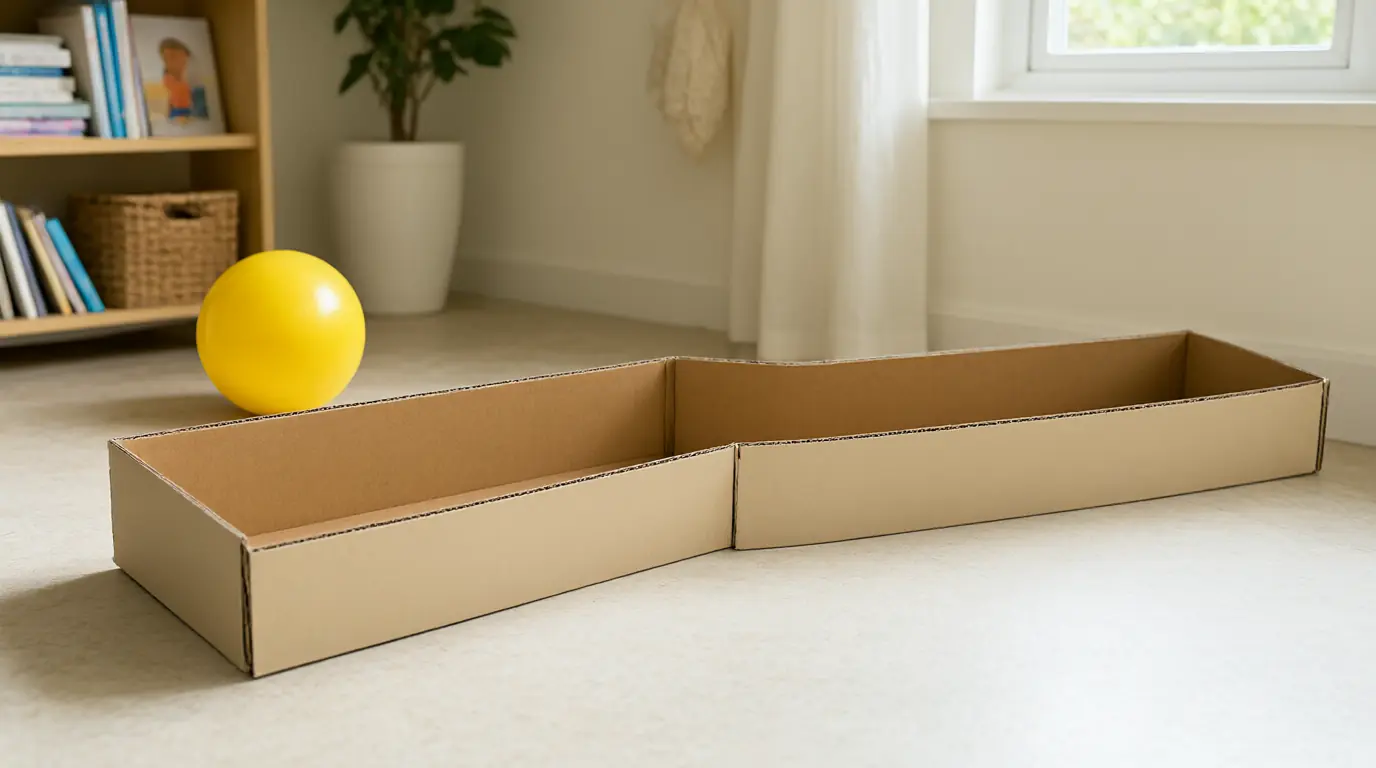
Make it your own: Offer a ready-made corner to a younger child and let them release the ball. Older children can add a third channel or a tunnel made from a cardboard tube.
The tube slide
A cardboard tube, such as a kitchen roll tube widened by rolling card, shows how a ball can disappear and reappear. Children delight in waiting at the exit, and the game gives a natural reason to talk about speed and direction.
You’ll need
- A long, wide cardboard tube or rolled card at least twice the ball width
- A large play ball
- A small cushion
- A towel on the floor
How to do it
- Check the ball slides through the tube without sticking.
- Rest the tube at a slight angle on a cushion.
- Drop the ball in at the top and wait at the bottom.
- Ask your child to guess how long it will take before it comes out.
- Make the tube steeper or flatter and count the seconds out loud.
- Try two tubes joined end to end.
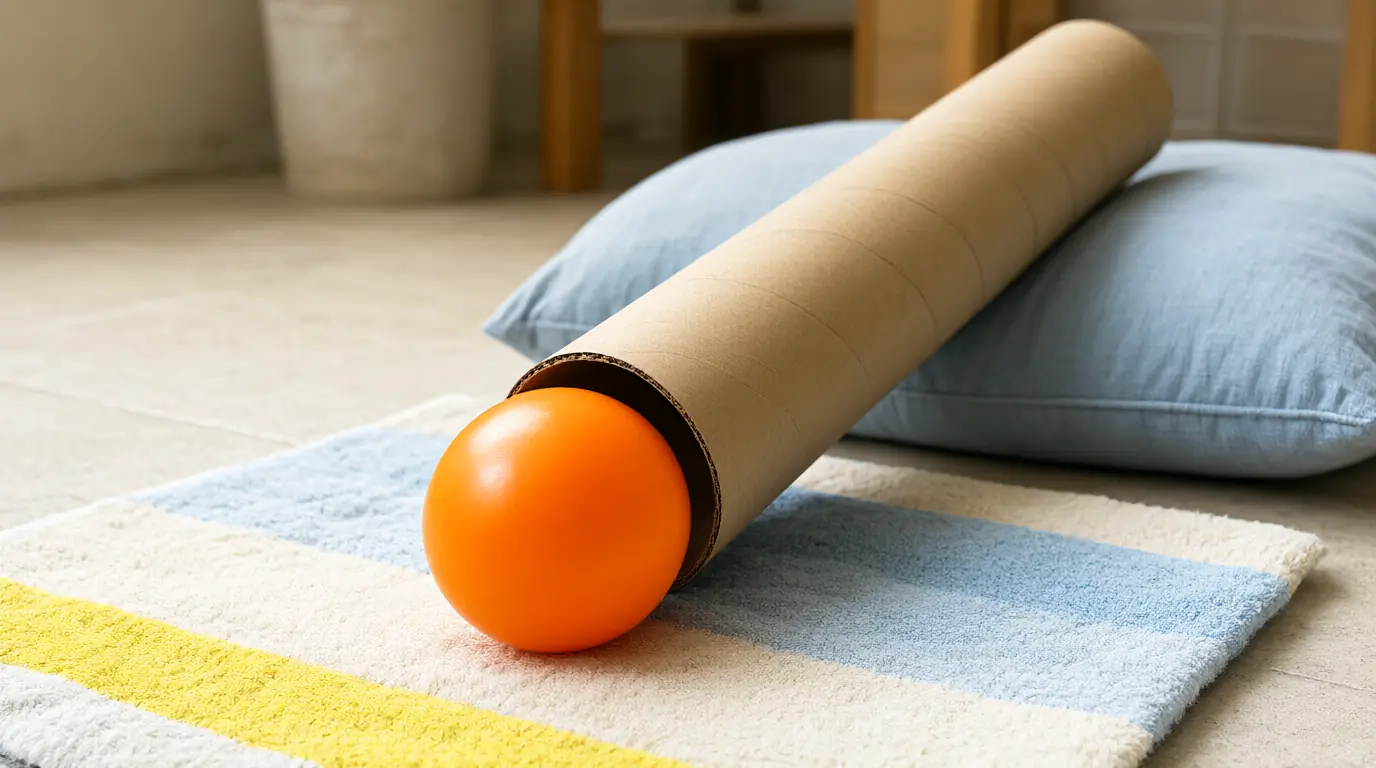
Make it your own: Use a short tube for a younger child so the wait is brief. Older children can time the ball with a sand timer or count claps.
Prediction markers
Predicting before a roll introduces an early scientific habit: guess first, then check. With two large floor markers at different distances, children can compare their guess with the result, and no one needs to be right every time.
You’ll need
- 2 flat floor markers, such as paper plates
- A low cardboard ramp
- A large play ball
- Masking tape for a start line
How to do it
- Place the plates at different distances from the bottom of the ramp.
- Ask your child to point to where they think the ball will stop.
- Release the ball and watch it roll.
- Check where it stopped, and say whether the guess was near or far.
- Change something, such as the ramp height, and ask for a new guess.
- Do three rounds and talk about what changed.
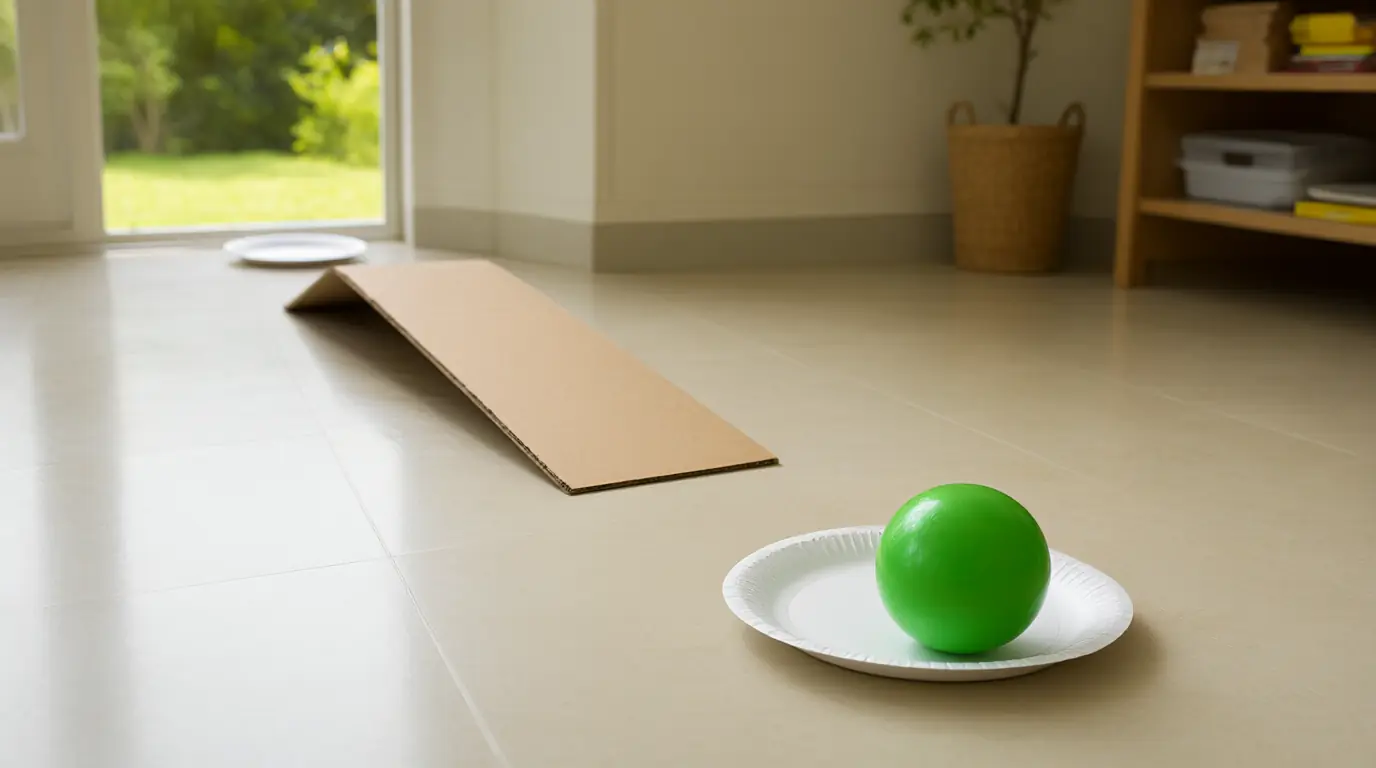
Make it your own: For younger children, use one marker. Older children can measure the distance with hand lengths or steps and compare.

Make it work for your family
Keep the playing space tidy and stop each round when the ball has stopped; running after a rolling ball is a common cause of trips. If balls keep leaving the area, build low walls from books or cushions. Let the child decide what to change, even if their idea looks less likely to work, because trying it teaches more than being told. Remember that real marbles belong with older children and adult supervision, so keep them in a closed container until they are needed.
Once your child enjoys rolling games, try the balance games for kids or add a counting challenge by tallying hits. For more ideas that build and test, see building games for kids or running games with rest breaks.

Parents also ask
At what age can children play with real marbles?
Marbles are small enough to be a choking hazard, so manufacturers typically label them for children aged three and over, and many families wait longer. For preschoolers, large play balls are a safer choice, and any marble play needs close adult supervision.
What can I use instead of marbles for young children?
Use large, age-rated balls, such as foam or rubber play balls, tennis balls or soft fabric balls bigger than a fist. They roll well on cardboard channels and floors and are much easier to see and catch.
How do I make a simple marble run at home?
Fold stiff cardboard into a wide U-shaped channel, tape the edges and rest one end on a book stack. Use a play ball that fits the channel with room to spare, and place a basket or towel at the bottom.
Choose materials and activities that suit your child, supervise as needed and adapt the ideas to their interests and abilities. About our editorial approach