Weebou Editorial Team
 7 min read

 In this article
A little preparation
Start with quantities your child can already count reliably, perhaps up to five or ten, and keep the objects large enough to handle comfortably. Large buttons, bottle tops or counting bears that are bigger than a coin are suitable for most five- and six-year-olds; anything small enough to swallow should be avoided with younger siblings around. Use a plain tray or mat so that every item is visible, and keep the rest of the table clear.
Sit side by side and say what you do as you do it. Instead of asking ‘What is the answer?’, ask, ‘How do you know?’ and let your child show you by moving objects or counting again. A child who recounts is checking, not failing. Keep games short, around ten minutes, and finish while your child still wants more. If your child is working on different numbers at school, ask the teacher which range to practise, and match it. Mistakes are useful: they show you what your child is thinking and give you something to talk about.

Ideas to try together
One cup for every guest
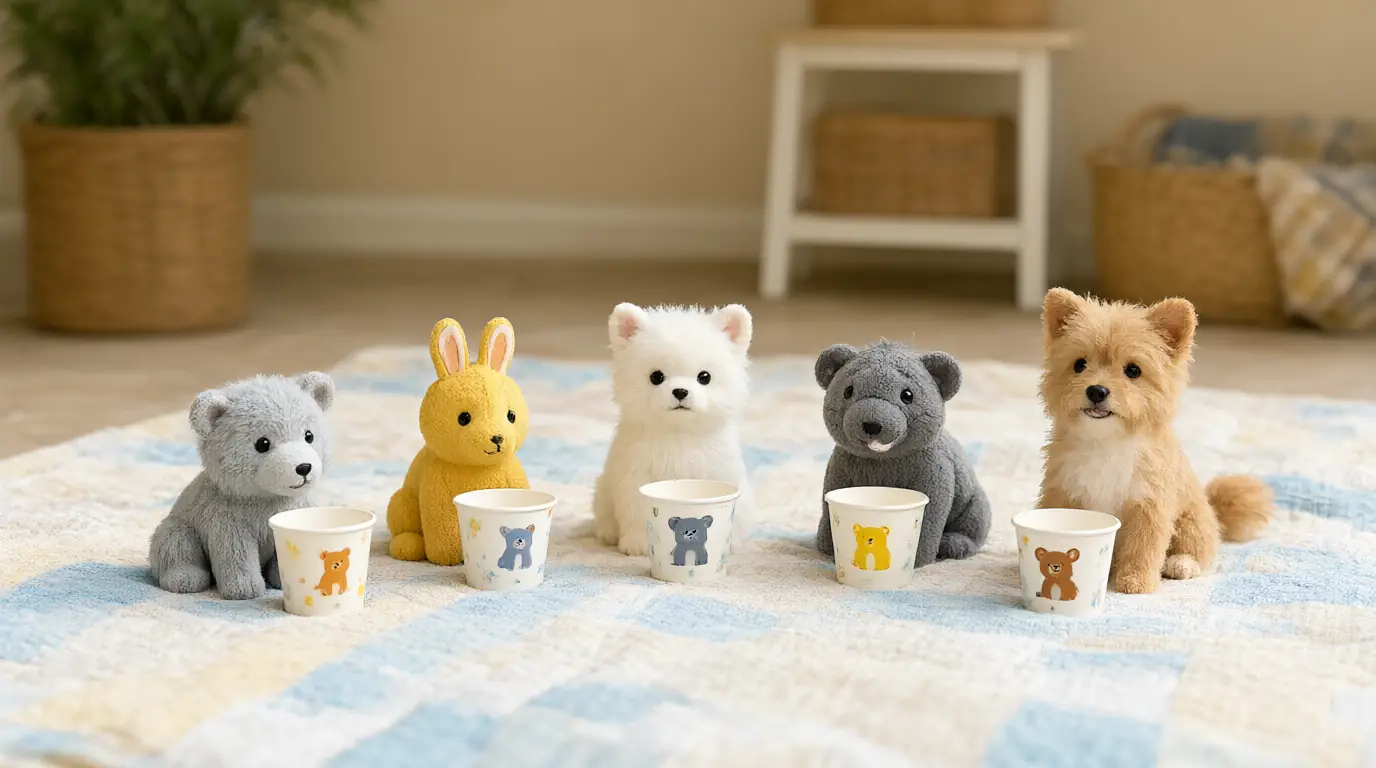
Matching one object to one person is the foundation of counting and, later, of division. A toy picnic gives your child a reason to check that nobody is missing out, and the cups provide an obvious test: if a guest has no cup, something is wrong. Adding a guest then shows why the number must change.
 You’ll need
- 5 paper cups
- 4 or 5 toy animals or dolls
- A blanket or tray for the picnic
How to do it
- Sit the toy guests in a circle and put the cups in the middle.
- Ask your child to give each guest a cup, one at a time.
- Check: ‘Does everyone have one? Are there any left?’
- Add a new guest and ask, ‘What needs to change?’
- Take away a guest and ask what happens to the extra cup.
Make it your own: For younger children, start with two or three guests. Older children can predict how many cups are needed before they hand any out.
Number parking
Linking a written numeral to a real quantity is a big step, and parking blocks in numbered spaces makes the link visible. Your child must read the symbol, count out the right amount and check it. The game works with any numbers your child knows, and it can be changed daily.
You’ll need
- A sheet of thick paper divided into 4 or 5 spaces
- A numeral written in each space with a marker
- 10 to 15 small blocks or toy cars
How to do it
- Lay the paper on the table and look at the numerals together.
- Choose a numeral and ask your child to park that many blocks in the space.
- Check by moving each block aside as you count it.
- Ask, ‘If we add one more block, which number is it now?’
- Swap: you park the blocks and your child checks whether you are right.
Make it your own: Younger children can use spaces numbered 1 to 3. Older children can add spaces up to 10 or place two numerals in each space.
Which tower has more?
Children often think a taller tower contains more blocks, but that is not always true, and finding out why is excellent maths. Comparing two towers, estimating and then counting puts your child in the role of investigator. The surprise when a short tower has the most blocks leads to real reasoning.
You’ll need
- 20 blocks of the same size
- A flat table or floor
- 2 sheets of paper to build on
How to do it
- Build one tall, thin tower and one wide, low tower with different numbers of blocks.
- Ask, ‘Which one do you think has more?’ and let your child guess.
- Take each tower apart and line the blocks up in rows.
- Count each row, touching each block once, and compare.
- Talk about what surprised you and why.
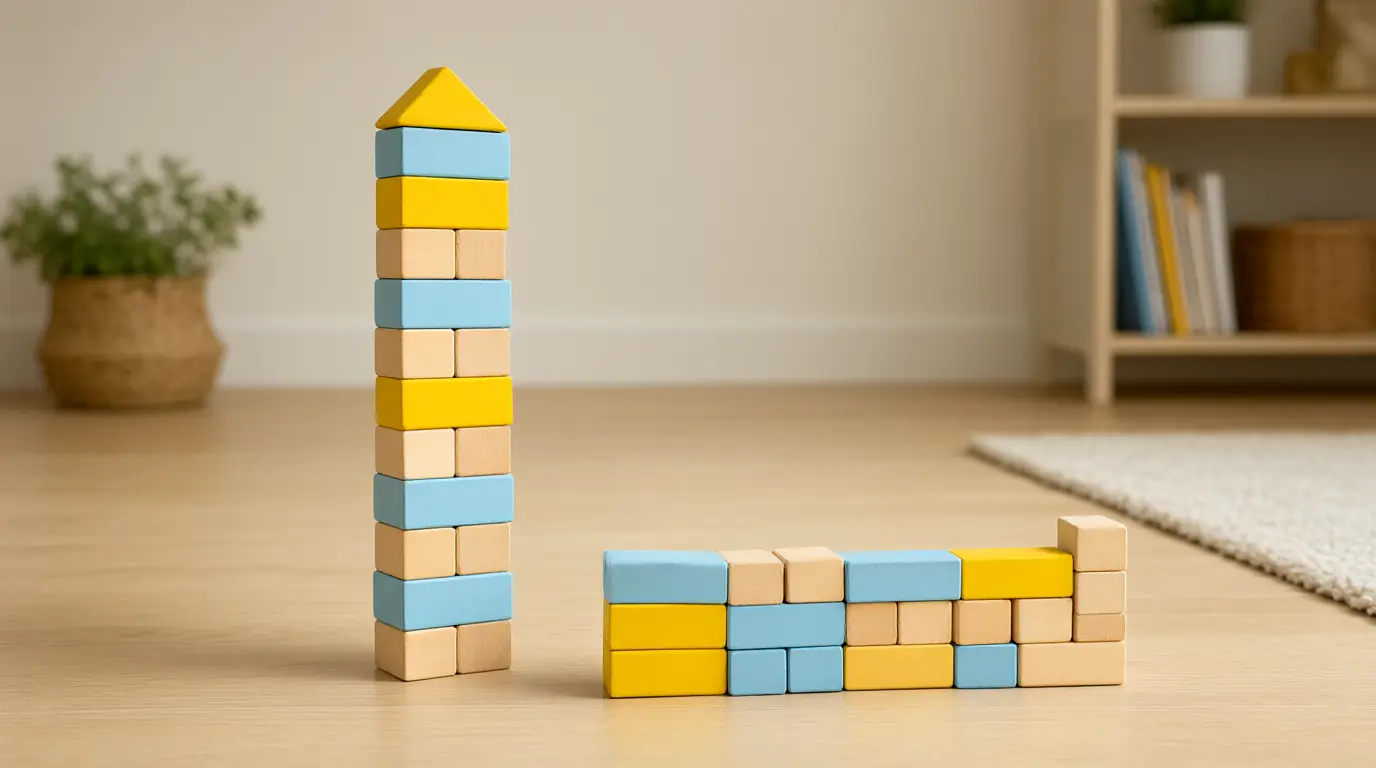
Make it your own: For younger children, use two towers with a very obvious difference. Older children can build a tower with exactly the same number of blocks as yours but a different shape.
Hide part of a group
Seeing some objects and working out how many are hidden is an early step towards subtraction and missing-number problems. The cup acts as a curtain, so your child can reason about what is behind it without seeing. Checking by lifting the cup gives instant feedback.
You’ll need
- 6 counters or buttons
- 1 opaque paper cup
- A tray
How to do it
- Show your child a group of five counters and count them together.
- Cover some of the counters with the cup while your child watches.
- Ask, ‘How many can you see? How many might be hiding?’
- Let your child guess, then lift the cup and count to check.
- Swap places: your child hides some and you work out how many.
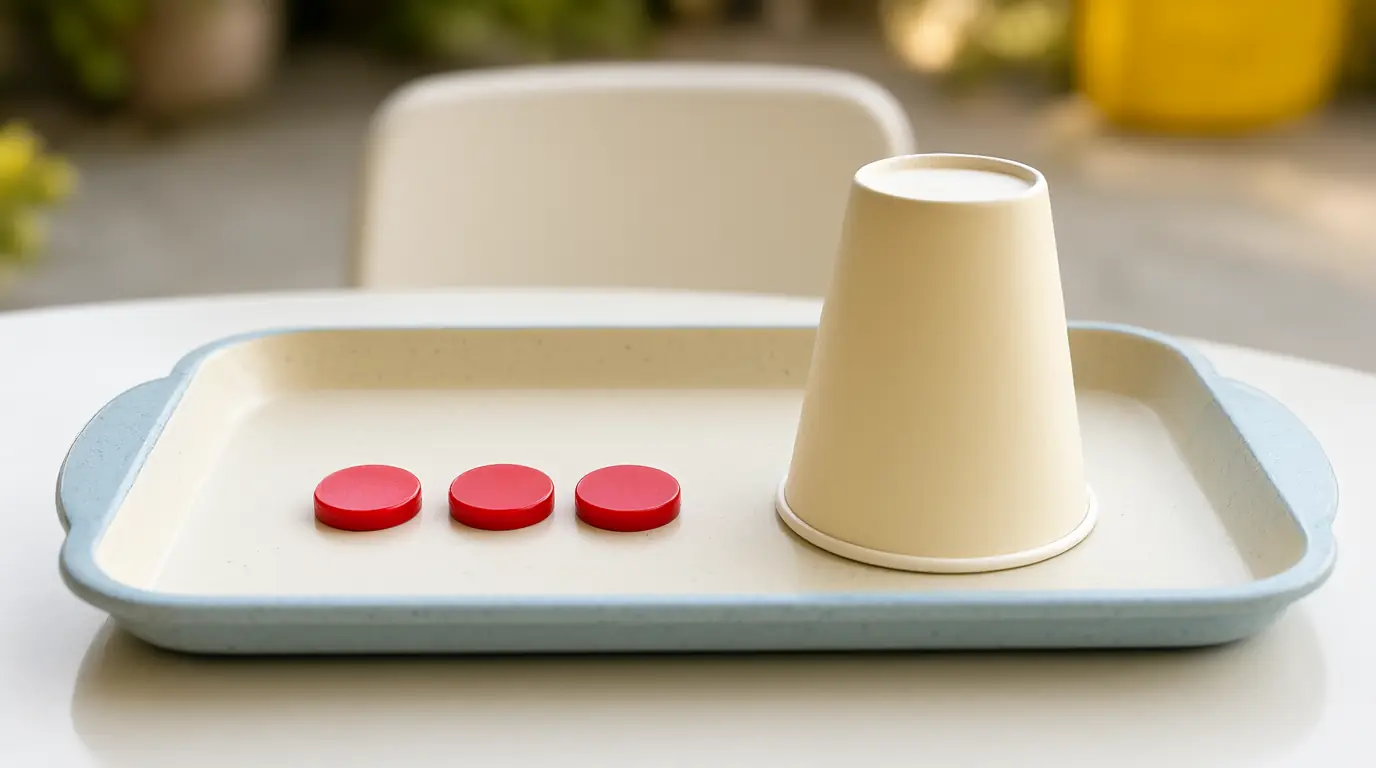
Make it your own: For younger children, use three counters and hide just one. Older children can start with eight and write the number they see and the number hidden.
Make ten with two cups
Knowing the pairs of numbers that make ten is useful throughout school maths, and a two-cup game makes it visible. Splitting ten counters between two cups shows that the same total can be broken into many parts. Your child discovers the pairs and notices patterns, such as one more in one cup meaning one fewer in the other.
You’ll need
- 10 counters of the same colour
- 2 paper cups
- A sheet of paper to record the pairs
How to do it
- Count ten counters together and check that there are ten.
- Ask your child to put some in one cup and the rest in the other.
- Lift each cup and count how many are in it, then say the pair, such as ‘six and four’.
- Draw a picture of the pair on the sheet.
- Try another way to split them and see how many different pairs you can find.
Make it your own: For younger children, use five counters and two cups. Older children can predict the number in the second cup before lifting it.

Make it work for your family
Let your child count again, rearrange the objects or start over, because speed is less important than connecting a number word, a quantity and an action. If a game is too easy, add a few more objects; if it is too hard, take some away. Watch whether your child touches each object once, says one number per object and knows the last number tells ‘how many’.
Short daily games work better than one long session. Look for chances to use the same ideas in real life, such as counting stairs or sharing biscuits. You can build on these games with these math card games using small numbers and these first-grade math questions for parents, and try the Weebou number games for extra practice.
Parents also ask
What math should a kindergartener know?
Skills vary by school, but kindergarteners are often working on counting to 20 or beyond, matching numbers to quantities, comparing groups, and putting small numbers together and taking them apart. Ask your child’s teacher what the class is focusing on.
How can I make math practice fun at home?
Use real objects and short games, such as sharing snacks, setting the table or building towers. Ask your child to explain how they know, not just to give an answer. Stop when attention drops, and return to it another day.
What if my child counts but cannot say how many there are?
This is common. Practise stopping at the last number and asking, ‘So how many are there?’. Counting objects as you touch each one helps, and recounting a group in a different order shows that the total stays the same.
Sources & further reading
Explore these primary sources for further context on this topic.
Choose materials and activities that suit your child, supervise as needed and adapt the ideas to their interests and abilities. About our editorial approach