Weebou Editorial Team
 7 min read
 In this article
A little preparation
Start with small quantities, such as one to five, and objects large enough for little hands to hold. Put everything on a clear tray or a rug so that nothing rolls away. Count aloud with your child and touch or move each item as you say its number; counting by pointing from a distance often leads to double-counting.
Choose a moment when your child is already interested, such as setting the table or tidying toys, rather than interrupting play. Keep sessions to about ten minutes, and keep small objects such as buttons away from children who still put things in their mouths. Accept that many children can say the number words before they can count objects accurately, so correct gently by recounting together. If you would like to see the same ideas inside a game, try the numbers game for kids.

Ideas to try together
Count the cups at the snack table
Setting a table gives counting a real purpose: every person needs one cup. This practises one-to-one matching, the idea that each object matches exactly one number or person. Children see what 'one more' and 'not enough' look like before they have to write anything down.
 You’ll need
- Paper cups or plastic beakers
- Paper plates
- Family members or teddies for guests
- Cards with numerals 1 to 5 (optional)
How to do it
- Decide who is coming to snack time, including teddies, and put one place mat for each guest.
- Ask your child to put one cup at every place, saying 'one for Dad, one for Mia' as they go.
- Count the cups together, touching each one, and say the last number again: 'four cups'.
- Take one guest away and ask whether there are too many or too few cups.
- Add a new guest and ask what you need to do to make it fair.
- Set a numeral card by the cups and ask whether it matches the number of guests.
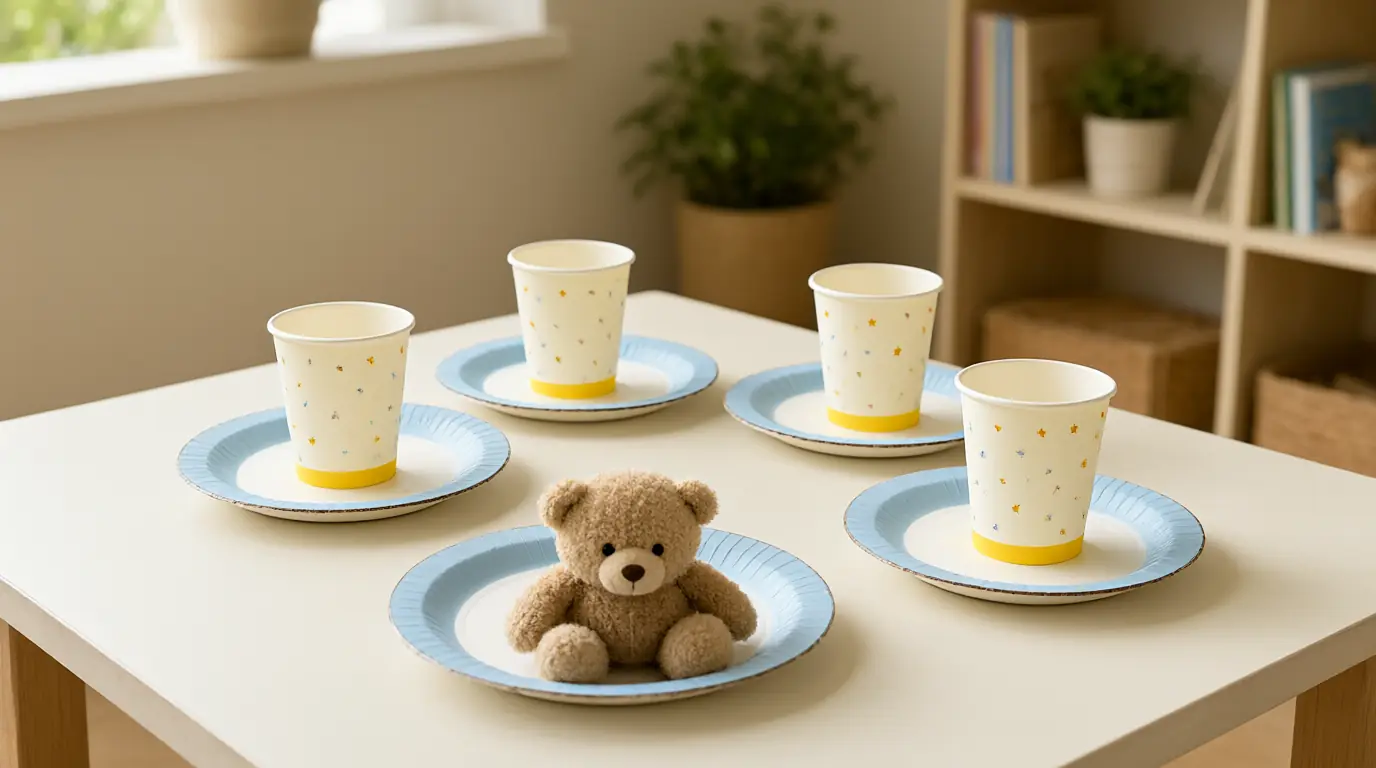
Make it your own: For two-year-olds, match one cup to one mat without counting aloud. For older children, set out plates in pairs and ask how many cups are needed for three pairs.
Build a tower to match the numeral
Linking a written number to a physical amount is a key step. Building a block tower for each numeral makes the amount visible, and comparing towers shows that bigger numbers mean taller stacks. Children can check their work by recounting and by laying the blocks flat.
You’ll need
- Large wooden or plastic blocks
- Index cards with numerals 1 to 5
- A tray
- A teddy or small toy to stand on top
How to do it
- Lay out the cards in a row and say each numeral together: one, two, three.
- Ask your child to choose a card and build a tower with that many blocks, counting as they stack.
- Count again from the bottom to check, then lay the tower flat and count a third time.
- Place the toy on top and say, 'This tower has four blocks'.
- Build a second tower for another card and ask which one is taller.
- Put the towers in order from smallest to tallest in front of the cards.
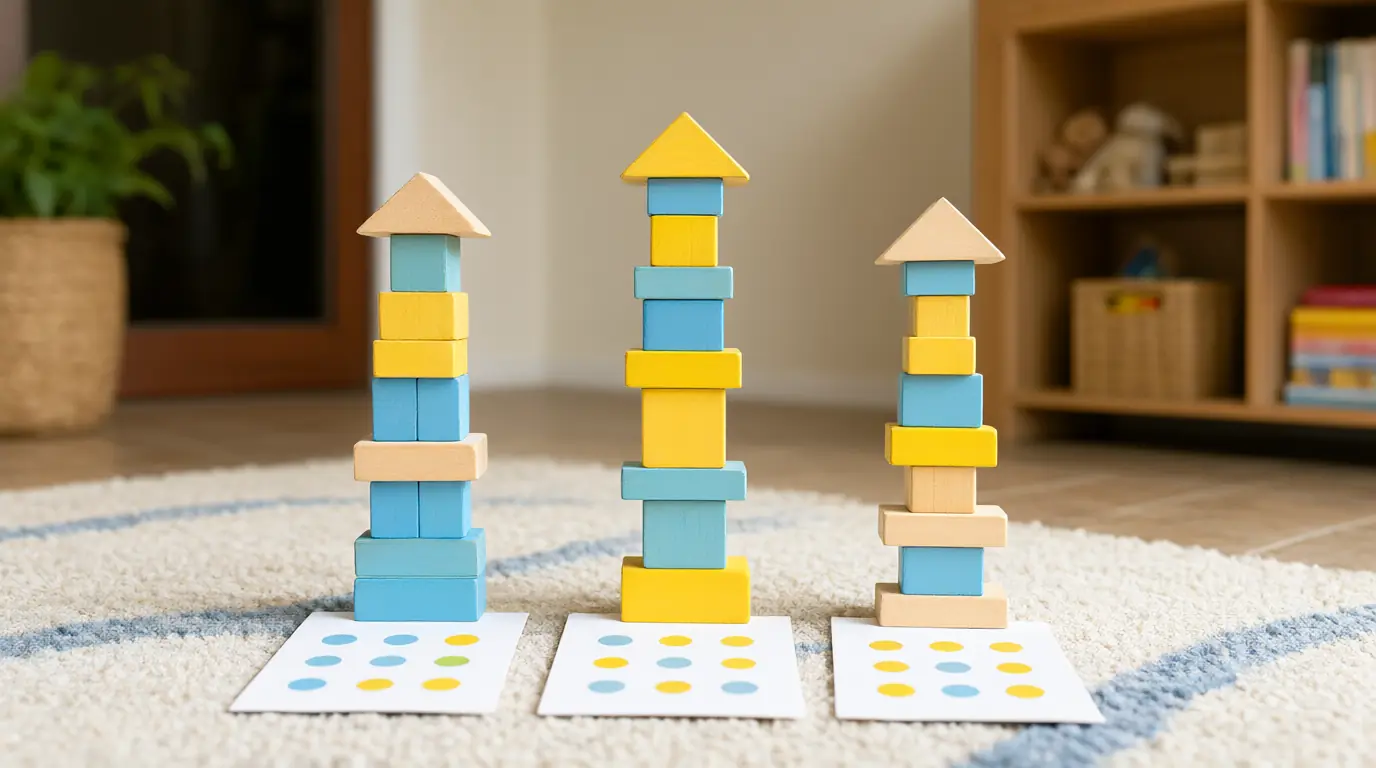
Make it your own: Younger children can build towers with two or three blocks and match them to dots instead of numerals. Older children can build to six or ten and try building a tower that is one block taller than a given card.
Hop, grab and count between two bowls
Moving objects from one place to another is a reliable way to keep track of what you have counted. The counted items end up in a different bowl, so there is no confusion over which ones are done. Adding a hop between bowls makes the game physical and helps energetic children focus.
You’ll need
- Two bowls or baskets
- Five to ten small soft toys or large pompoms
- A dice or number card
- Masking tape to mark a path
How to do it
- Put the toys in the first bowl and place the second bowl a few steps away along a taped path.
- Roll the dice or pick a card to decide how many toys to carry.
- Hop or walk to the second bowl and drop in one toy at a time, counting each one aloud.
- Look back at the first bowl and ask how many toys are left.
- Count the toys in the second bowl to check that the numbers match what you rolled.
- Take turns, and at the end count all the toys together.
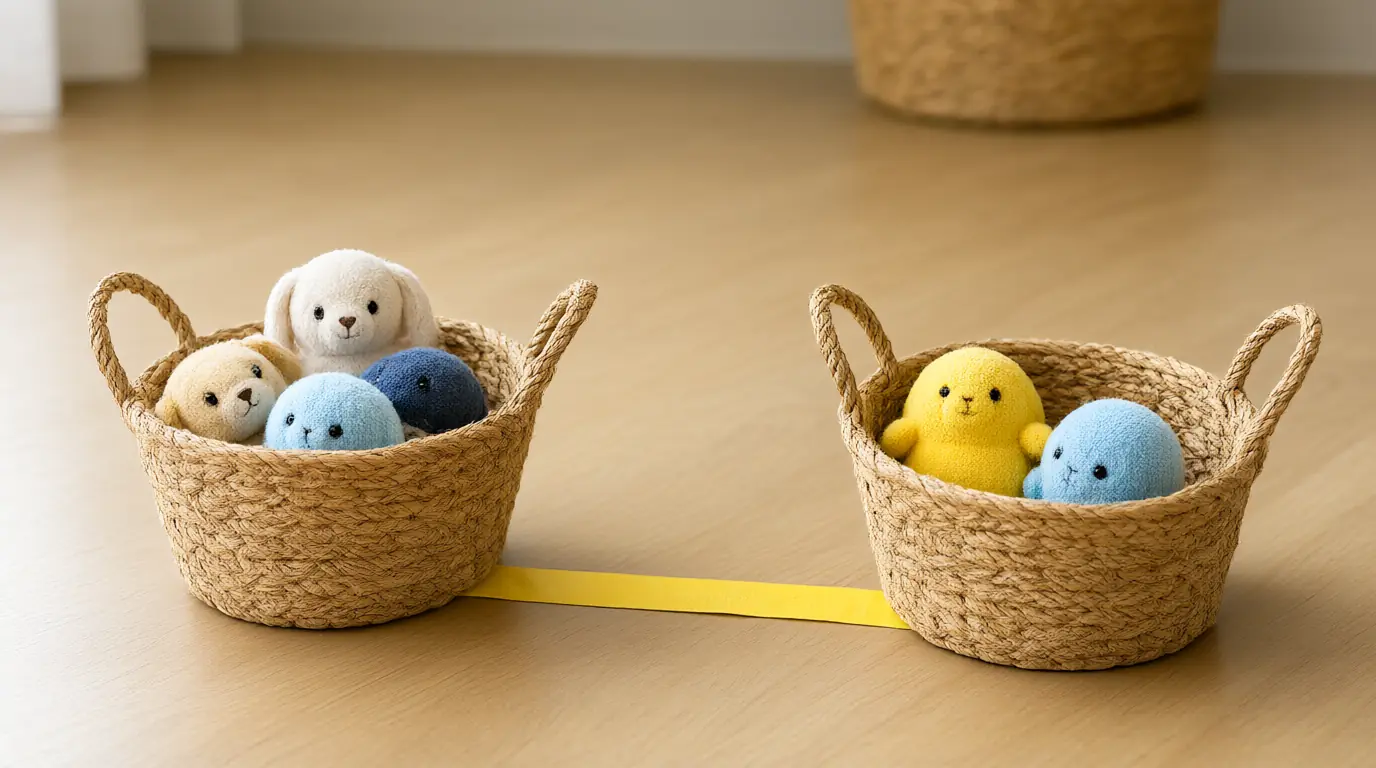
Make it your own: Younger children can carry one toy at a time and count only to three. Older children can try carrying two at a time and counting in twos, or guess how many are left before looking.
Change the arrangement, check the number
Young children often think that a longer row has more objects. Spreading and squeezing a set of toys, then recounting, helps them discover that the number stays the same when the arrangement changes. This idea takes time, so there is no need to rush it or to tell them the answer.
You’ll need
- Five identical small toys, such as toy cars or building bricks
- A tray or table
- A sheet of paper to cover them
- Two numeral cards, 4 and 5
How to do it
- Line up five toys in a short row and count them together: one, two, three, four, five.
- Ask your child to close their eyes while you spread the toys into a long row with big gaps.
- Ask whether there are still five, or more, or fewer, and listen to their reason.
- Count them again, touching each one, and compare with the first count.
- Move the toys into a tight pile and ask the same question.
- Cover the pile with paper and ask your child to say how many are hiding underneath, then check.
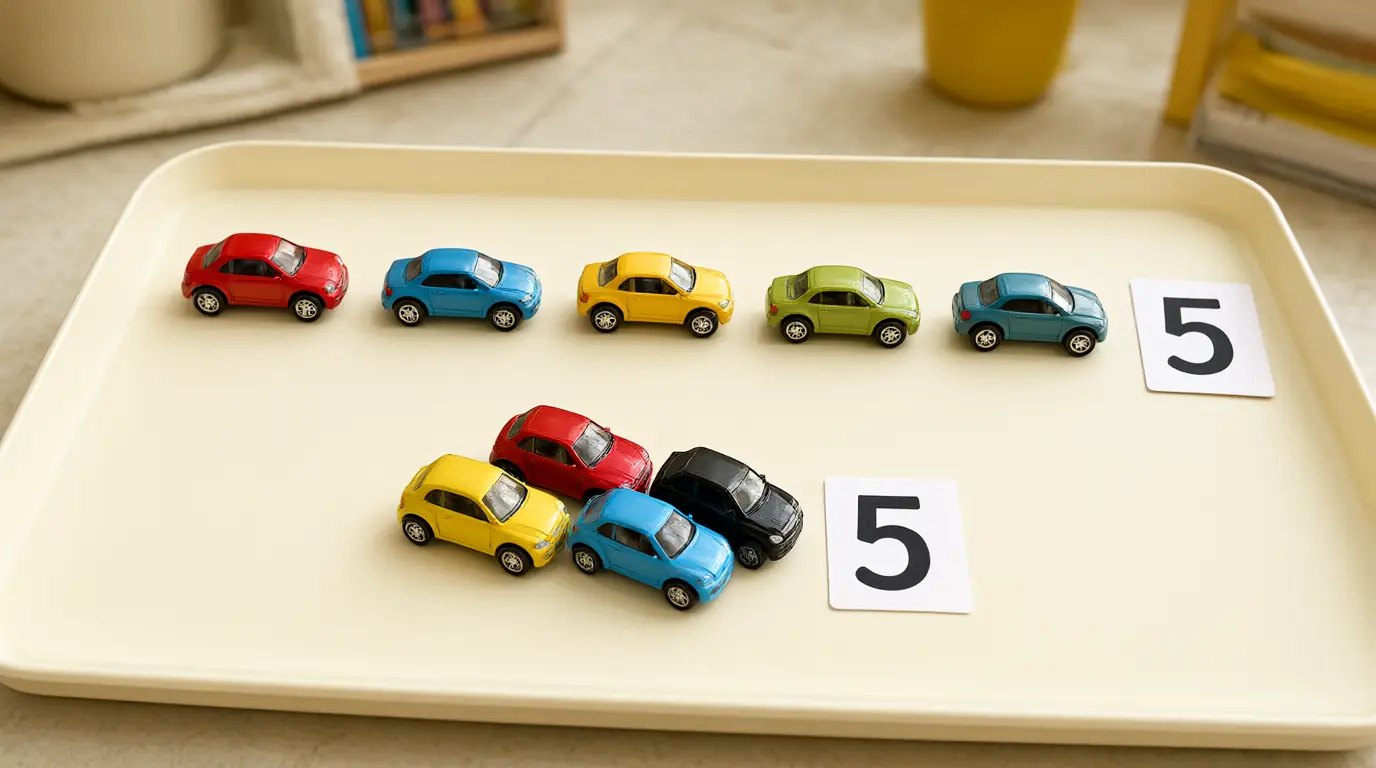
Make it your own: For younger children, use three toys and match them to fingers. Older children can predict before you move the toys and explain why they think the number has or has not changed.

Make it work for your family
If your child counts correctly but cannot say how many there are, ask "So how many cups altogether?" and let them answer after the last item. Many children go back to the start and recount, which is a normal stage. Resist the urge to rush ahead to bigger numbers; counting to ten with understanding is worth more than reciting to thirty.
If your child is confident with small amounts, add one more or take one away and ask what changed. A common mistake is thinking a spread-out row has more objects than a tight pile; recount together rather than telling them they are wrong. For the next steps, look at preschool maths hidden in everyday play and money games with a pretend shop.
Parents also ask
How high should my child be able to count by age 4?
Children vary a lot. Many four-year-olds can say number words up to ten or beyond, and count a small set of objects accurately. Accurate counting of a handful of items matters more than reciting a long sequence. Ask your child's teacher if you are unsure.
Should my child learn to write numerals before counting?
Counting objects usually comes first. Children recognise numerals more easily once they know that a number means an amount. Writing numerals can follow later, using big movements, sand or chalk, and does not need to be neat at the beginning.
Why does my child skip numbers when counting?
Skipping or repeating numbers is common while children learn the sequence and one-to-one matching. Slow down, touch each object as you count and move counted items to a separate pile. Practise short sequences, such as one to five, in songs and routines.
Sources & further reading
Explore these primary sources for further context on this topic.
Choose materials and activities that suit your child, supervise as needed and adapt the ideas to their interests and abilities. About our editorial approach