Weebou Editorial Team
 8 min read
 In this article
A little preparation
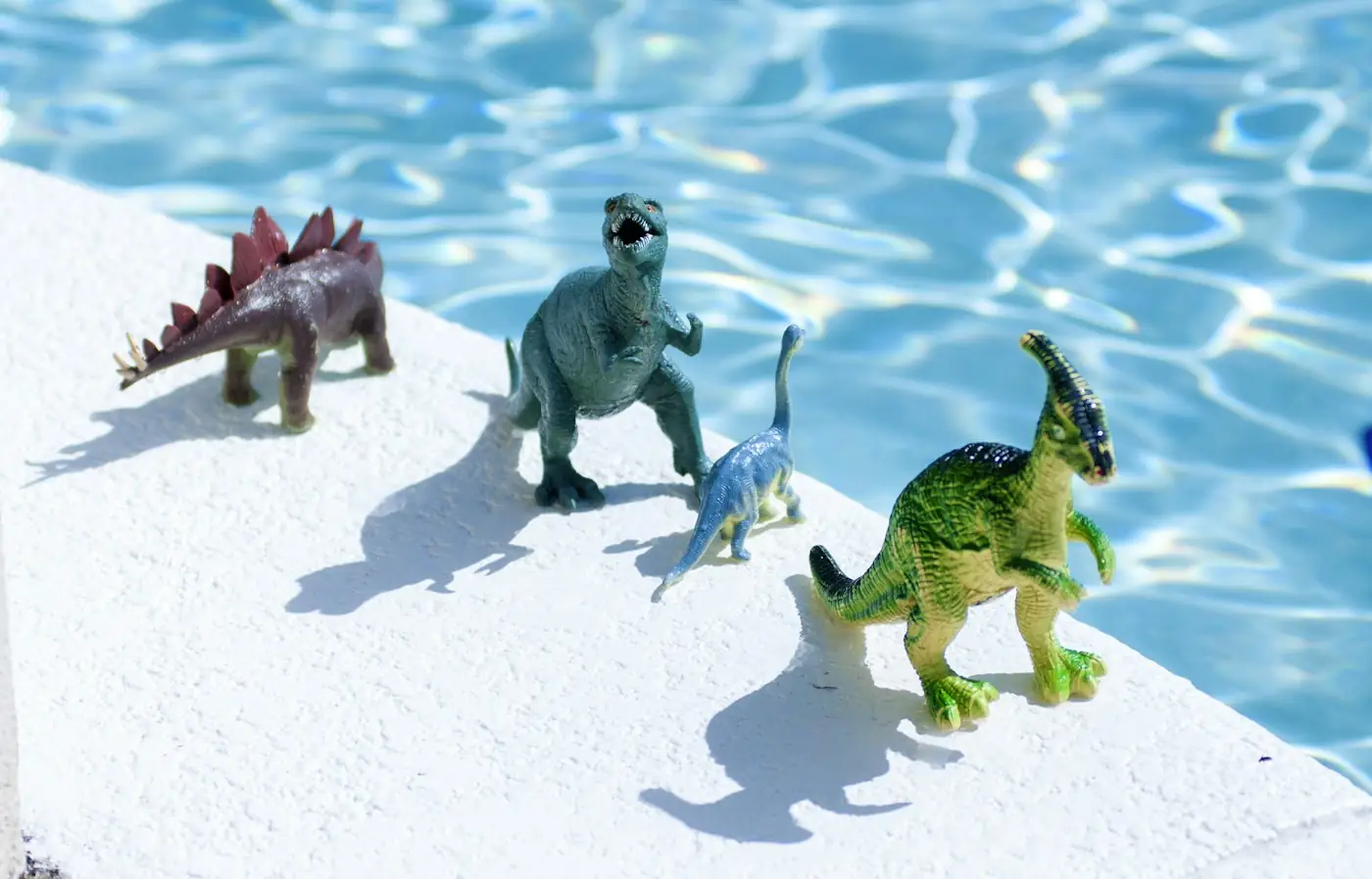
Pick a surface that can handle a bit of mess, such as a tray, a floor mat or a table covered with newspaper. Check dinosaur toys for loose or broken parts, and keep tiny pieces away from anyone who still mouths objects. Dinosaur pictures work just as well as toys if you do not own any, and a library book with large illustrations is an excellent shared resource.
When your child asks a question you cannot answer, that is a good thing. Say ‘I do not know, shall we find out?’ and look it up together in a children’s non-fiction book or a museum website afterwards. A few facts are worth knowing in advance: no people lived at the same time as the big dinosaurs, most dinosaurs died out about 66 million years ago, and scientists think birds are living descendants of small feathered dinosaurs. Keep pretend and fact visibly separate, and allow ten to twenty minutes per game.

Ideas to try together
Follow the footprint trail
Paper footprints on the floor invite a child to step, stretch and imagine a huge animal passing by. Scientists really do study fossil footprints to learn how dinosaurs moved, so a trail like this is a playful first step into that idea. It is also a great way to practise big, careful movements.
 You’ll need
- Large sheets of brown or grey paper
- A marker pen
- Scissors (adult use)
- A toy dinosaur and a cushion nest at the end
How to do it
- Trace around your hand and fingers, or draw a big three-toed footprint, onto paper; an adult cuts out eight to ten.
- Lay them in a winding trail across the floor, with some close together and some wide apart.
- Ask your child to be a detective and follow the trail, placing each foot on a print.
- Stop at the wide gaps and talk about what kind of animal would take such big steps.
- Arrive at the nest and discover what is waiting there, a toy, or a picture your child has drawn.
- Move some prints and let your child lay a new trail for you.
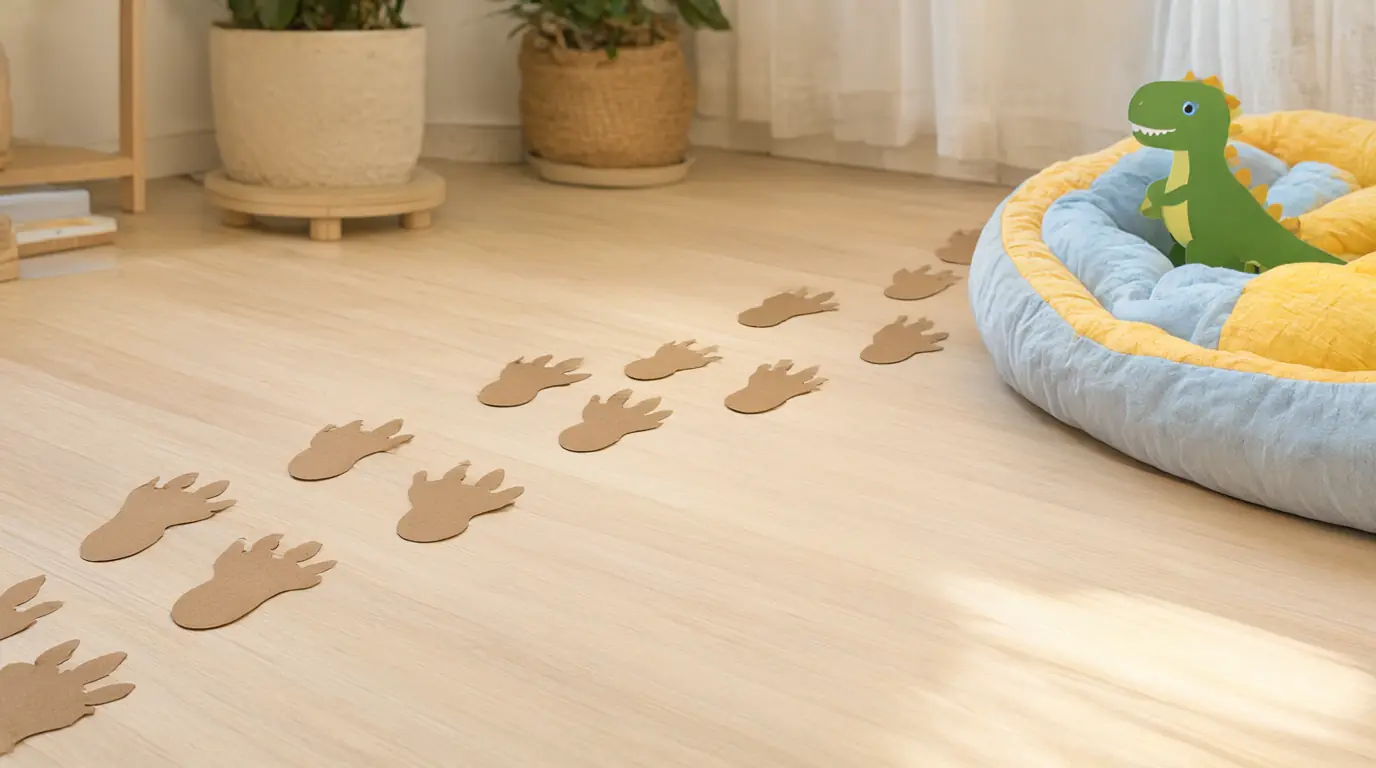
Make it your own: For younger children, make the footprints close together and use only a short trail. For older ones, make the steps different sizes and ask which animal took the biggest and which took the smallest.
Press a pretend fossil
A real fossil takes a very long time to form, but pressing a toy into dough gives children a quick, tactile model of an impression. They see how the shape is left behind and compare what different toys leave. It is a lovely way to link careful looking with fine-motor work.
You’ll need
- A handful of play dough or air-dry clay
- A tray or board
- 2 or 3 plastic dinosaur toys with textured feet or backs
- A small paintbrush for brushing the dough
How to do it
- Roll the dough into a flat, thick pancake on the tray.
- Choose one toy and press its foot or back firmly into the dough.
- Lift the toy slowly and look at the mark it left.
- Press a second toy beside the first and compare the two shapes.
- Brush the surface gently with the paintbrush, as a scientist would clean a find.
- Say clearly that this is a model of an impression, and a real fossil is stone that took a very long time to form.
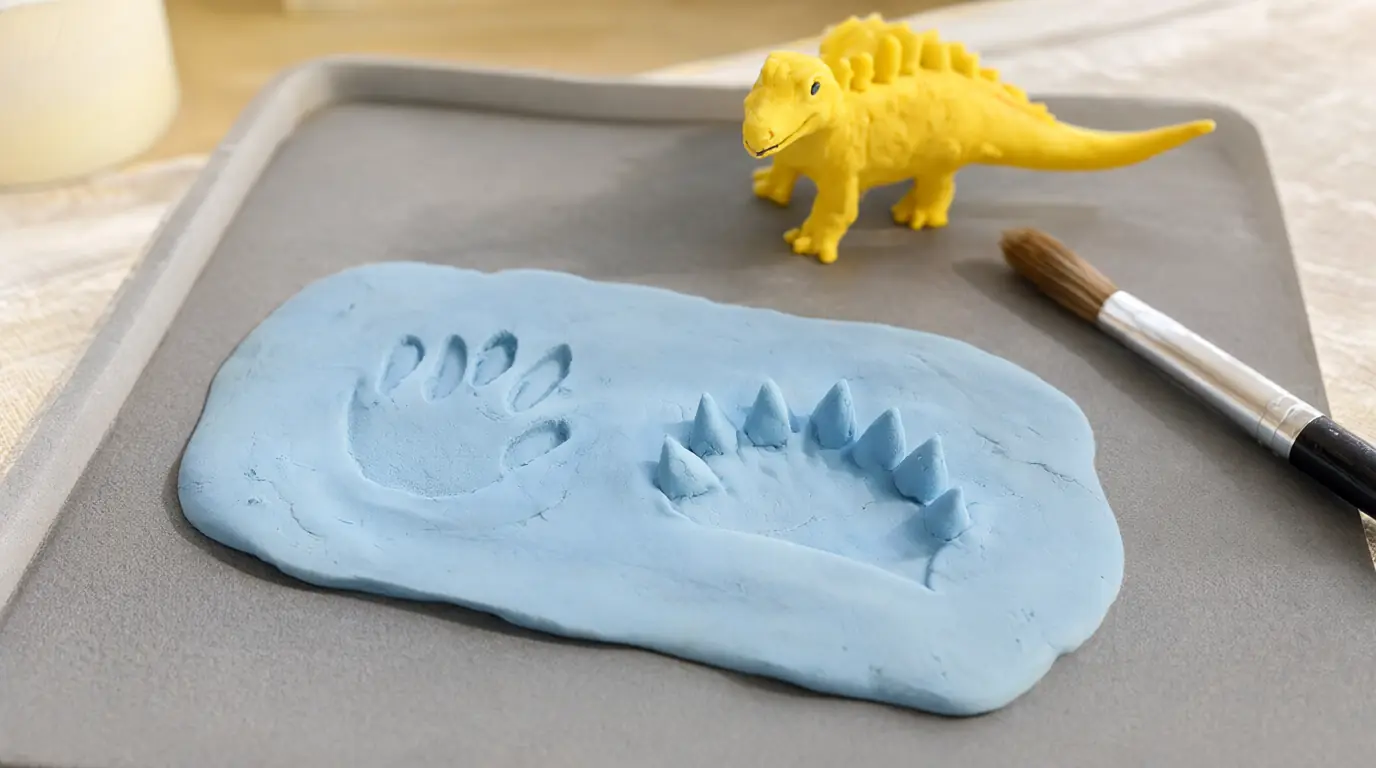
Make it your own: Younger children can press their own hands and feet first. Older children can hide a toy, ask a partner to make an impression, then guess which toy made it.
Measure the giants with string
Some dinosaurs were no bigger than a chicken, others longer than a bus, and a length of string helps children feel the difference. Comparing against their own height and arm span gives measurement a real meaning. The game also encourages the language of long, longer and longest.
You’ll need
- A ball of string or wool
- Scissors (adult use)
- A tape measure or ruler
- A few sticky notes or paper tags with drawn dinosaur outlines
How to do it
- Choose two or three dinosaurs from a book that lists their lengths.
- Cut a piece of string for each length, helping your child read or hear the number.
- Lay the strings in a line on the floor or lawn, with one end at the same starting point.
- Let your child lie down along each string, or walk heel to toe, to see how many of them fit.
- Put a picture tag on the end of each string.
- Ask which one is longest, and how many children it would take to stretch to the end.
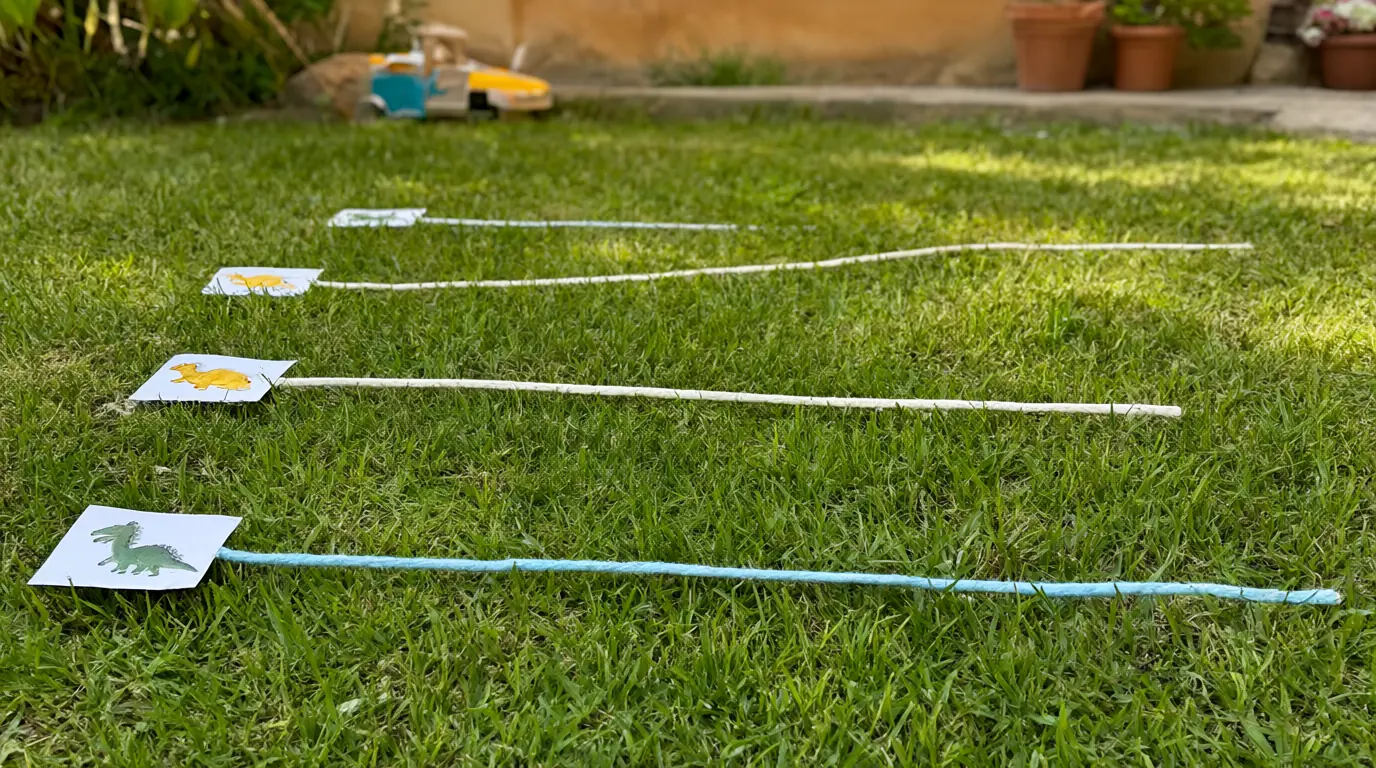
Make it your own: Younger children can compare only two strings, short and long. Older children can use a ruler or foot-length measurements and write down the numbers.
Open a tiny dinosaur museum
A pretend museum gives children a reason to sort, describe and explain. Curators have to look closely at each object, decide where it goes and tell visitors something about it. It turns a pile of toys into a project that you can build over several days.
You’ll need
- 5 to 8 dinosaur toys or picture cards
- A table or shelf
- Blank index cards for labels, drawn by your child
- Small paper tickets and a shoebox for entry
How to do it
- Clear a table or low shelf and let your child choose which dinosaurs to display.
- Group them together in a way your child chooses, for example by size, colour or the way they walk.
- Ask your child to draw a picture label for each one, and write down their words on a card.
- Open the museum and invite family members to visit with paper tickets.
- As the guide, your child describes each dinosaur and answers questions.
- Write down one question you cannot answer and look it up together afterwards.
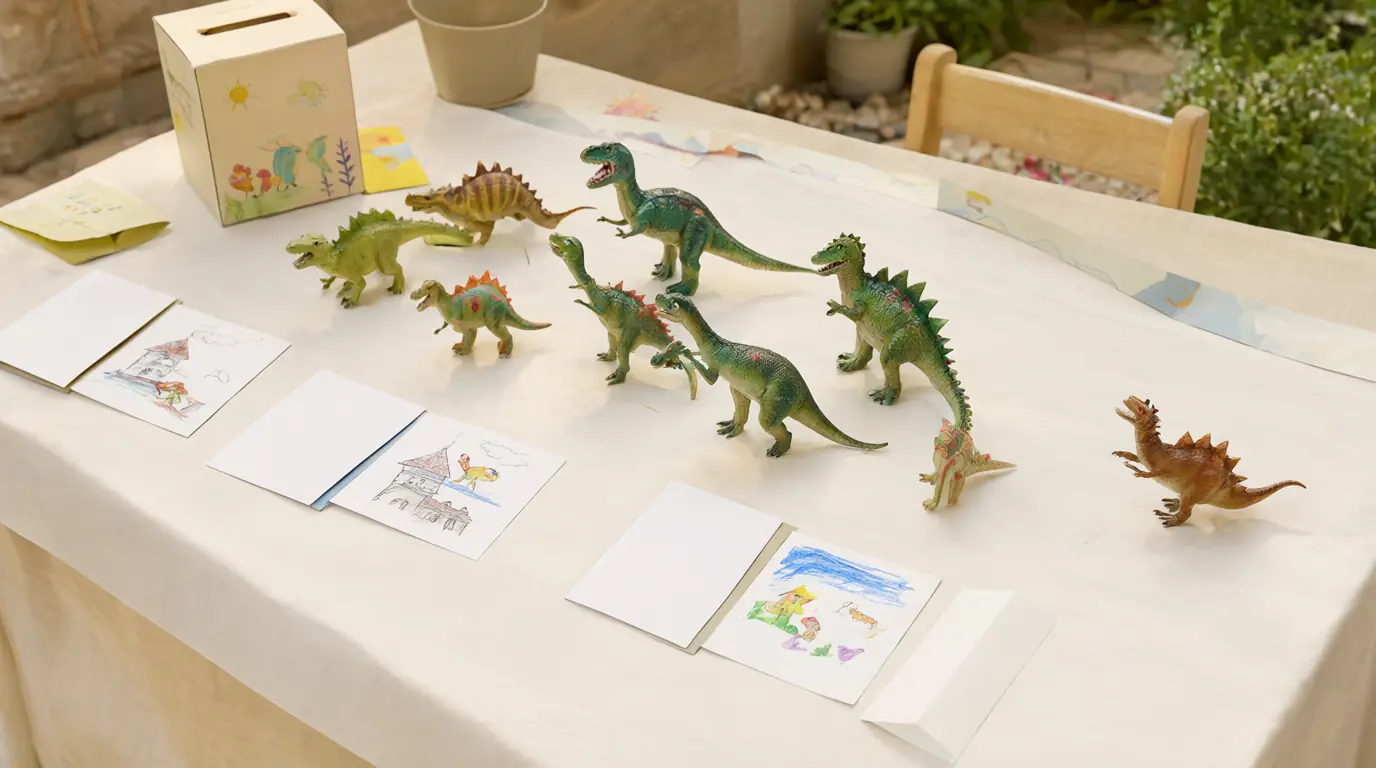
Make it your own: Younger children can simply line up the dinosaurs and tell a visitor their favourite. Older children can sort the exhibits into two groups, plant-eaters and meat-eaters, using a book to check.
Build a habitat in a box
A shoebox habitat lets a child decide what a dinosaur’s world might look like and then tell a story inside it. Building a scene encourages planning, cutting and sticking, and the box makes it easy to display and revisit. You can talk about what a plant-eater would need to find nearby.
You’ll need
- A shoebox, turned on its side
- Green and brown paper, cotton wool, small stones
- Child-safe glue
- 1 or 2 small dinosaur toys
How to do it
- Lay the shoebox on its side and cover the inside floor with brown paper for the ground.
- Tear or cut green paper into fern-like leaves and stand them up with glue.
- Add a pool of blue paper for water and a few stones around it.
- Place the dinosaur toy inside and ask what it might want to eat or drink.
- Tell a short story together about a day in this world.
- Change one thing, such as adding a nest, and see how the story changes.
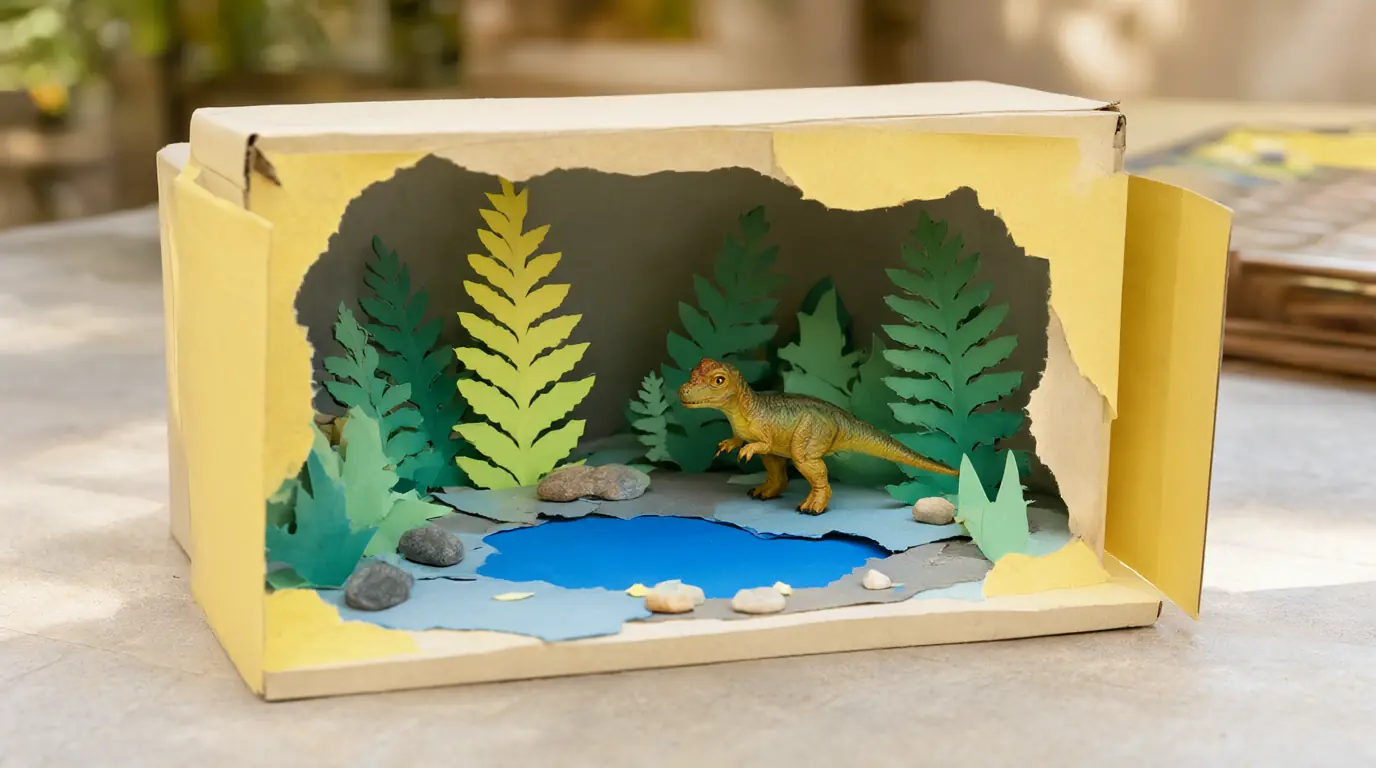
Make it your own: Younger children can glue large torn paper pieces without worrying about shape. Older children can plan the box first with a drawing, then check a book about what plants lived with dinosaurs.

Make it work for your family
If a child announces a dinosaur ‘fact’ that sounds odd, do not correct it harshly. Ask where they heard it, say ‘I wonder if that is true, shall we look?’ and check together. This keeps curiosity alive and shows that people double-check what they know. Resist quizzing on long names; most children are happier telling you what a dinosaur does than pronouncing it.
For more nature-based play, try animal games for kids or a few of the science games for kids. If your child wants to build the habitat in sand, you may like the sand play ideas for roads, patterns and small landscapes. A library visit with a stack of picture books is the best follow-up to any of the five games.

Parents also ask
What dinosaur facts are suitable for young children?
Simple, well-established facts work best: dinosaurs lived a very long time ago, some were tiny and some enormous, some ate plants and some ate meat, and birds are descended from dinosaurs. Avoid stories about people living with dinosaurs, as they did not.
Is it fine to mix pretend and real dinosaur play?
Yes. Pretend play is how children make sense of ideas. You only need to say clearly when something is a story and when it is a fact you checked, for example ‘in our game the dinosaur has a nest, and in the book scientists say some dinosaurs did lay eggs.’
How do I keep a dinosaur-loving toddler safe during play?
Use large toys with no loose parts, and watch for brittle plastic that may snap. Supervise closely with play dough and clay, which can be mouthed, and keep scissors and glue out of reach unless an adult is using them.
Choose materials and activities that suit your child, supervise as needed and adapt the ideas to their interests and abilities. About our editorial approach