Weebou Editorial Team
 8 min read
 In this article
A little preparation
Walk the space yourself before the children do. Look for uneven ground, holes, bikes, dog mess, gates, water and anything that moves, and decide where the game can happen and where it cannot. Mark the edge with something children can see from a distance: four cones, a rope laid on the ground, or a line of upturned buckets. Say the boundary out loud and walk it together once, because a child who has touched the edge is far more likely to remember it.
Choose one stopping cue and practise it before the real game starts. A clap pattern, a whistle or a call such as 'freeze and look at me' all work if children have heard it in a calm moment. Bring water and a hat or sunscreen if it is bright, and a layer if it is cool. Plan about 15 to 20 minutes for each game, then let children drift into free play. If other families share the space, keep your area compact and put the quieter roles on the side nearest to them.

What to know and try
Landmark delivery
Two visible landmarks, such as a tree and a bench, each get a picture name. Children carry a matching card from a starting basket to the right landmark and come back for another. It builds route planning, memory for pictures and a sense of direction, and it works in a space only a few steps wide.
 You’ll need
- 2 landmarks inside the boundary
- 6 picture cards, 3 for each landmark
- A basket at the starting spot
- 2 matching pictures to fix to the landmarks
How to do it
- Fix or lean one picture at each landmark and name them together, for example 'the apple tree' and 'the red bench'.
- Show the cards and sort one example into each pile so children see how the matching works.
- Let one child pick a card from the basket and decide where it belongs.
- Walk, skip or tiptoe to the landmark, place the card at its foot and return.
- Swap roles so a second child checks the delivered cards against the pictures.
- Finish by carrying all the cards back and re-sorting them for the next round.
Make it your own: For younger children use only two cards and walk alongside them. Older children can deliver in a set order, memorise two cards at once, or follow a spoken sequence such as 'tree, then bench'.
Chalk choice trail
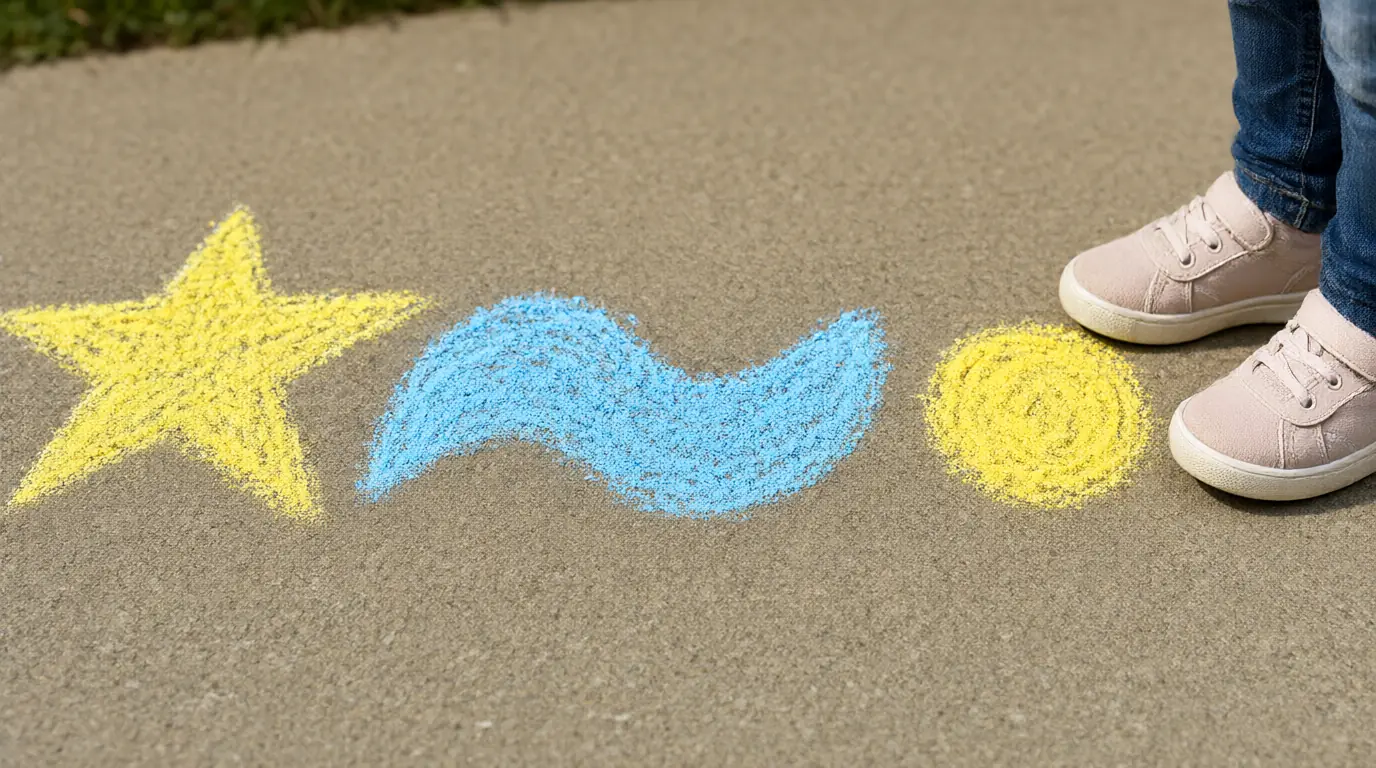
A line of big chalk shapes becomes a trail with an action attached to each one. Children decide how to move over a star, a wave or a dot, and then add a symbol of their own. It gives movement a clear structure and lets children be the designers, while the chalk keeps everyone moving in one direction.
You’ll need
- Chalk, on a surface where it is permitted
- A cleared stretch of pavement or flat ground
- A bucket of water and a brush for washing it away later
How to do it
- Draw five large shapes in a line, about a long step apart.
- Agree what each shape means: star means stretch up, wave means wiggle your arms, dot means tiny steps.
- Walk the trail once slowly with your child doing each action.
- Invite your child to draw one new shape and say what it means.
- Walk the changed trail together, and ask the group to try the new action.
- Rinse or brush the chalk away afterwards as part of the game.
Make it your own: A toddler can simply stamp on each shape. Older children can make a trail of ten shapes and test whether a friend can remember the order, or draw a trail with two choices at a fork.
Soft ball roll to a low target
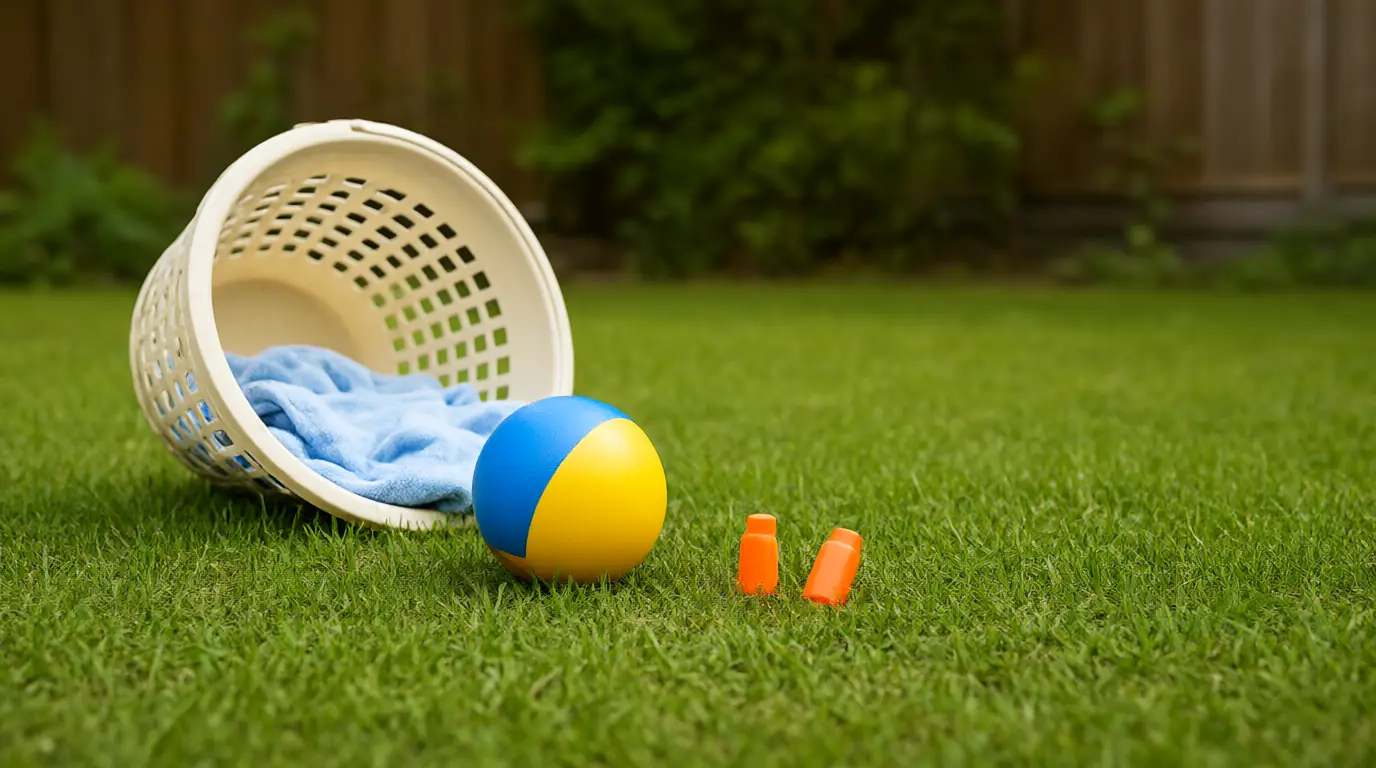
A basket on its side, a hoop on the ground or a gap between two bags makes a low, wide target. Rolling a soft ball towards it works on aim, force and patience while avoiding the crowding that throwing games sometimes cause. A fixed place for waiting keeps everyone's path clear.
You’ll need
- 1 soft, light ball
- A basket, box or hoop lying on the ground
- 2 markers for a rolling line
- A rope or cones to show where to wait
How to do it
- Place the target on flat ground and put a marker about two big steps away.
- Show a gentle underarm roll and let your child try a few practice rolls.
- Let everyone stand or sit behind the waiting line while one child rolls.
- When the ball stops, one child walks out to bring it back while the others stay put.
- Move the marker forward or back and ask whether the roll needs to be harder or softer.
- Count how many rolls it takes to land in the target, not to beat anyone else.
Make it your own: Younger players can sit very close and push the ball. Older children can try rolling with the other hand or aiming for a gap between two objects.
Listen and locate sound map
Stopping to listen turns a familiar space into something new. Children point towards sounds, such as birdsong, a distant engine or a gate, and then draw a simple map of where each one came from. It sharpens attention and gives quieter children a worthwhile way to take part.
You’ll need
- A clipboard or hard book
- Paper and thick crayons
- A mat or blanket to sit on
- A sheet with a circle drawn in the middle
How to do it
- Sit on the mat and agree to be quiet for about 30 seconds, then close or soften your eyes.
- Listen for sounds and point with a finger when you hear one.
- Draw a small symbol for each sound on the circle, placing it in the direction it came from.
- Take another quiet turn and add anything new.
- Compare the maps: which sounds did everyone notice, and which did only one person hear?
- Keep the map and listen again the next time you visit.
Make it your own: Young children can draw just one sound and tell you about it. Older children can mark near and far sounds with different colours, or guess how many sounds there were before listening.
Shadow and sun-spot chase
On a bright day, shadows give every child a partner who always follows. Stretching, shrinking and hiding a shadow introduces light and distance in a way no explanation could, and the game works on any flat surface in the sun. Keep it calm and slow so that no one has to race.
You’ll need
- A sunny day and a flat area
- A skipping rope or chalk to mark the boundary
- A few large leaves or sticks to lay on the ground
- A bucket of water for washing chalk off afterwards
How to do it
- Stand with your back to the sun and look at your shadow, then wave an arm to see it move.
- Ask your child to make theirs tall, then small, then very wide.
- Play follow the leader with shadows: one child makes a shape, and the others copy it.
- Trace one shadow with chalk and return an hour later to see if it has moved.
- Hide your shadow in a bigger shadow by standing next to a tree, a wall or a parent.
- Finish by lying down to rest in a patch of shade.
Make it your own: For a cloudy day, use a flashlight and a wall instead. Older children can predict where a stick's shadow will fall at different times and check their guess.

Make it work for your family
Always keep a seated or slower role available, such as card keeper, sound listener or ball retriever. Children who need a breather can step into it without leaving the game, and children who are cautious about running get a way in that feels worthwhile. Swap roles every few minutes so that nobody is stuck with the 'easy' job all afternoon.
When the game starts to wobble, because someone has wandered, the weather has turned or another group has arrived, stop, regroup and redraw the edge instead of shouting across the space. Games can end earlier than planned and still have been a good game. For a collecting-and-noticing alternative, try an outdoor scavenger hunt, or read about yard games if you have a private patch of lawn to play on.

Parents also ask
What are good outdoor games for a 3-year-old?
Games with one simple job work best: carrying a card to a landmark, rolling a soft ball at a low target or following a chalk trail. Keep the boundary small, stay within arm's reach and finish after ten or fifteen minutes.
How can I play outdoor games in a small space?
Choose games with a fixed path rather than free running. Landmark delivery, sound mapping and chalk trails need only a few steps of ground and can be played in a courtyard, on a balcony with permission or in a corner of a park.
How do I keep children inside the boundary?
Show the edge with something visible, such as a rope or cones, walk it together and practise a stop signal before the game starts. If a child keeps leaving, shrink the space or add a task that gives them a reason to stay near the middle.
Choose materials and activities that suit your child, supervise as needed and adapt the ideas to their interests and abilities. About our editorial approach