Weebou Editorial Team
 In this article
A little preparation
Pick a quiet moment rather than the middle of a party: after breakfast, on a car journey or just before bed works well. Read one riddle at a time and pause after each clue so your child has time to picture it. Offer two picture choices or place two real objects on the table when a guess is wanted, and treat a near-miss as a real answer by asking which clue led there. If your child prefers moving to sitting, the sound riddles and the trail work better than a list read aloud.
Keep the tone friendly: no dark rooms, no jump scares and no pretending to be a monster, even in fun. If you use small props such as a toy spider or wrapped sweets, keep them away from children who still mouth objects, and stay with younger children for the whole trail. Ten to fifteen minutes is usually plenty for one sitting. If you want more low-pressure guessing before you start, these gentle guessing games use the same listen-and-check rhythm.

Questions to explore together
Riddles about pumpkins, brooms and skeletons
Start with things your child can already picture: a pumpkin on a step, a broom by a gate, a paper bat on a string. The clues describe what an object looks like and where it sits, so children can match words to something they know rather than hunting for a trick. Read each one slowly and let the last line hang in the air before anyone answers.
How to do it
- I am round and orange with a green curly hat, and someone drew a smile on me before leaving me by the door. What am I? — A pumpkin.
- I stand in a field with straw in my sleeves and a floppy hat on my head, and the crows stay away from me. What am I? — A scarecrow.
- I have a long wooden handle and a bundle of bristles, and a witch might lean me against the gate. What am I? — A broom.
- I am white from head to toe, I grin without any lips, and if you shake my hand I rattle. What am I? — A skeleton.
- I am made of thin paper and I hang from a thread, and I have two wings but I never fly. What am I? — A paper bat decoration.
- I am small and square with twisted ends, and I rattle against my friends inside a bag. What am I? — A sweet.
Make it your own: For a three-year-old, lay out three real or pictured objects and let them point while you read. Older children can add a fourth clue of their own, or write the answer on a folded card for someone else to solve later.
Animal riddles with friendly night clues
Animals are a safe place to practise riddling because almost any answer can be talked through. Each clue here names something the creature does rather than something it looks like, so children have to think about habits and times of day. Once a child has guessed two, ask them to make up a clue about an animal they know well.
How to do it
- I sleep hanging upside down, my wings are like leather and I come out when the sky turns pink. What am I? — A bat.
- I have eight legs and eight small eyes, and I spin a net that nobody uses for fishing. What am I? — A spider.
- I am black from nose to tail, I purr on a warm doorstep and some people say I bring luck. What am I? — A black cat.
- My eyes are round, my head turns far around and my voice is a long hoot in the dark. What am I? — An owl.
- I carry my house on my back and leave a silver trail on the path after rain. What am I? — A snail.
- I am grey with pointed ears and a long nose, and I sing up at the moon. What am I? — A wolf.
Make it your own: Younger children do better with two animal pictures to choose between. Older ones can hide the animal's name from themselves by covering the answer with a finger while they read the clue aloud to you.
Costume riddles to guess the character
Costume riddles turn dressing up into a thinking game. Instead of asking what someone is wearing, the clues describe the pieces one at a time, so a child builds the character in their head before saying the name. This suits children who are already planning their own outfit, and it gives you an easy way to talk about what makes a costume recognisable.
How to do it
- I am tall and pointed, I sit above someone's hair and I match a long dark cloak. What am I? — A witch's hat.
- I am a white sheet with two eye holes, and I say ooo as I drift across the room. What am I? — A ghost costume.
- I am a cardboard box painted green with a shell on my back and four small feet stuck to the front. What am I? — A turtle costume.
- I have a red cape, a hood and a basket, and I am walking to my grandmother's house. Who am I? — Little Red Riding Hood.
- I am a paper crown and two shimmering wings hanging on a coat hanger, and I carry a wand with a star. What am I? — A fairy costume.
Make it your own: For younger children, hold up the actual hat or cape as you read. Older ones can hide the clues and describe their own costume in three sentences while you guess, which is harder than it sounds.
Sound riddles to answer out loud
Some riddles are sounds rather than objects, and the answer is a noise your child can make. That shift from thinking to doing keeps a restless child involved, and it shows that a riddle can live in your ears as well as your head. Read the clue, then let everyone make the sound together before you name it.
How to do it
- I am the noise a door makes when it swings open very slowly in an old house. What am I? — A creak.
- I am the sound dry leaves make when two feet walk through them. What am I? — A rustle.
- I am a long hoo-hoo coming down from a high branch. What am I? — An owl.
- I am the laugh a witch gives when her pot bubbles over. What am I? — A cackle.
- I am the rattle a dancing skeleton makes when it moves its arms. What am I? — A rattle.
- I am the whoosh a cape makes when someone turns around quickly. What am I? — A whoosh.
Make it your own: For a toddler, make the sound yourself and let them copy it. Older children can give a sound clue for you to guess, or add a second sound that belongs with the first, such as footsteps and then a creak.
A riddle trail around the house
A trail turns riddles into a small expedition. Each clue describes a place rather than an object, so children have to think about where they are standing as well as what they are hearing. Five stops is enough for most young children, and the last one gives the game a clear ending instead of trailing off.
 You’ll need
- Five small cards or squares of paper
- A thick pen
- Tape or sticky putty
- A sticker, small treat or drawn pumpkin for the end
- One or two picture clues for a child who cannot read yet
How to do it
- Write five short place clues on separate cards, for example: I am cold inside and I keep the milk. Look inside me. (The fridge.)
- Add a simple drawing beside each clue so a pre-reader can follow it without help.
- Hide the cards in order: under the table, behind the sofa, in the shoe basket, beside the bath, on the bed.
- Read the first card together, then walk to the place it names and find the next one.
- Let your child carry the cards and decide which way to go, even if it is the long way round.
- Finish at the last card with a sticker or drawn pumpkin, then let your child hide one card for you to find.
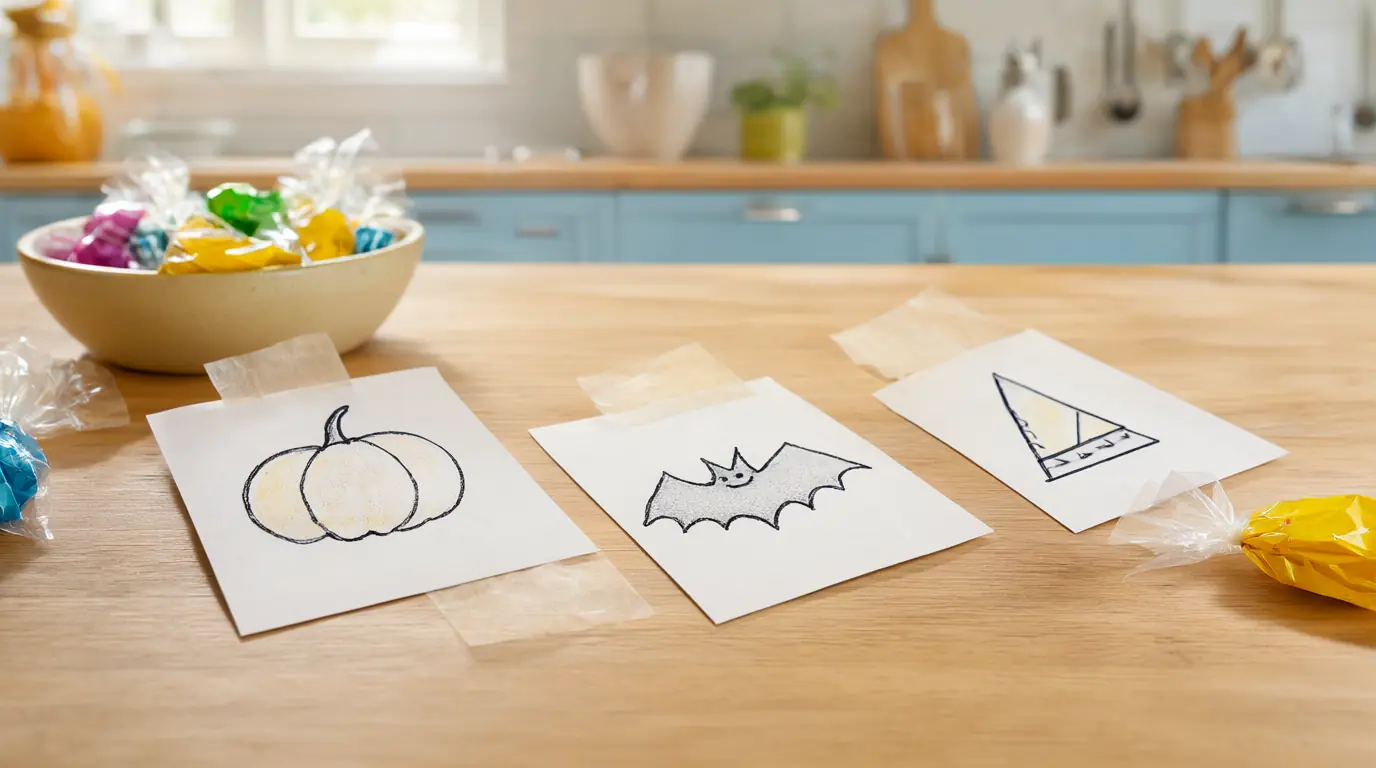
Make it your own: For younger children, use three stops and pictures only. For older ones, leave the answer off the card and make the clues slightly vaguer, or let them write the whole trail for a sibling or a visiting grandparent.

Make it work for your family
If a child is stuck, do not repeat the same riddle louder. Give the answer and ask which clue fits it best, then read the riddle again so the connection becomes clear. Children who guess wildly are usually enjoying the turn-taking more than the puzzle, so let them invent an answer and explain why it could work. A child who says 'I don't know' may simply need the picture clue first and the words second.
Stop while it is still fun, and keep the answer sheet where you can see it rather than testing your own memory. Repeat the favourites over the following days: recognition is part of the pleasure, and a child who has heard a riddle three times will often deliver it to somebody else. For simpler clues about everyday objects, try these easy riddles about everyday things, or swap in a few silly Halloween jokes when the guessing runs out.

Parents also ask
What are good Halloween riddles for young children?
The best ones describe familiar objects and give the answer clearly, such as a pumpkin with a drawn smile, a broom by the gate or a paper bat on a string. Avoid riddles that depend on wordplay or scary images, because a four-year-old is still building the vocabulary needed to follow them.
How do you help a child who cannot guess the answer?
Give the answer, then read the riddle again and ask which clue fits it best. Offering two picture choices also helps, because choosing between two things is easier than searching for a word. Keep the answer sheet nearby so nobody has to wait through several wrong guesses.
What age are Halloween riddles suitable for?
Simple object riddles work from about four years, when children can hold a few clues in mind at once. Three-year-olds usually prefer being told the riddle and pointing at a picture, while five- and six-year-olds start inventing their own clues and repeating favourites to other people.
Choose materials and activities that suit your child, supervise as needed and adapt the ideas to their interests and abilities. About our editorial approach